
Welcome to our latest Market Watch update, where we keep you informed about the latest developments in the sea and air freight industries. From ongoing delays at the Panama Canal to geopolitical risks in the Suez Canal, we delve into the challenges facing carriers. Additionally, we explore space constraints on the Asia to North America route and the stability of air freight rates. Stay tuned as we provide insights into what to expect in the coming weeks and offer recommendations for navigating potential disruptions in cargo movement.


Panama Canal

We continue to see delays for ships crossing the canal. The authority stated they will maintain 24 authorized transits per day until April. If rains arrive in May as expected, the canal plans to progressively increase daily slots, aiming to return to about 36 vessels per day, its normal number during the rainy season.

Suez Canal

With uncertainty around a potential for ceasefire in Gaza we see Houthi attacks as a continued risk to carriers.

Asia to North America

We are hearing that following post Lunar New Year blank sailing strategy coupled with canal issues may cause space issues in first half of March as factories restart. GRI will be pushed to second half of March. Expect more blank sailings for March if demand doesn’t improve.


Asia to North America

Air freight rates continue to maintain rate levels as e-commerce shipments from China are quite robust.


Expect delays into March however as new vessel deliveries come onto market we may see schedules start to stabilize.

For time sensitive cargo:

  • East Coast: We recommend shipping to West Coast and either transload or connect to rail option if available.
  • Use Premium Services offered by carriers to guarantee space and equipment and reduce delays.


MILLION

Projected container imports into major U.S. ports in February, in 20-foot equivalent units, up 2.8% from January’s estimated imports and 20.4% ahead of February 2023.
Source: Global Port Tracker.

Crew abandons ship after Red Sea missile attack, despite US fight-back
The crew abandoned ship after a missile attack on general cargo vessel Rubymar last night, some 35 miles from the Yemen coast, despite US naval strikes over the weekend which were claimed to have reduced Houthi capabilities.
– Read More


India renews open sky policy for foreign air cargo carriers
In a significant move, India has liberalised its aviation policy to permit foreign cargo airlines to operate out of all its international airports – a mandate lasting three years.
– Read More


West Coast leads latest surge in US container imports
The start of 2024 is bringing with it significant growth in volumes at top U.S. ports. January witnessed a 9.2% year-over-year increase in inbound containers. This rise represents the latest reading in four consecutive months of growth, a beacon of positive momentum after a challenging period dominated by the post-pandemic downturn.
– Read More


Praying for rain as record lows loom for Panama Canal and Amazon
Water levels in the Gatun Lake – the man-made reservoir which dictates the navigability of the Panama Canal – are again sinking below the 80ft (24.3 metre) threshold and looking set to pass the record low levels seen last year.
– Read More


The Inland Empire’s once-unstoppable warehousing industry falls into a slump
For years the growth of warehousing in the Inland Empire was relentless. At the confluence of port-bound freeways and rail spurs along the eastern edge of Los Angeles’ sprawl, box-like fulfillment centers popped up in business parks by the millions of square feet. They were an economic engine, a bringer of jobs, a shortener of commutes, and a workhorse during the pandemic.
– Read More


Rise of fast-fashion Shein, Temu roils global air cargo industry
NEW YORK/SHANGHAI, Feb 21 (Reuters) – The rapid rise of fast-fashion e-commerce retailers such as Shein and Temu is upending the global air cargo industry, as they increasingly vie for limited air-cargo space to woo consumers with rapid transit times, more than ten industry sources said.
– Read More


Asia gateways scramble as Gemini alliance plans big shift to feeder port network
Gemini Cooperation, the Maersk/Hapag-Lloyd alliance due to launch next February, is set to downgrade some of the carriers’ current key cargo gateways in Asia to feeder ports under its proposed “hub-and-spoke” network linking Asia with Europe, the Mediterranean and North America.
– Read More


Panama Canal revenues up 14.9% in 2023 despite transit restrictions
In 2023 the Panama Canal’s revenues increased by 14.9% to $4.97 billion despite handling less cargo due to draught and transits restrictions caused by drought.
– Read More


FMC rules for truckers in chassis dispute with ocean carriers
The US Federal Maritime Commission (FMC) has ordered ocean carriers to stop mandating that cargo owners and their truckers use specific chassis on merchant haulage business, a decision that could shake up how containers are transported in the US.
Read More


Air Force runs trials with autonomous cargo planes
Autonomous electric cargo plane builder Pyka this week delivered the first unit in a fleet of three Pyka Pelican Cargo aircraft on lease to AFWERX, the innovation arm of the Department of Air Force (DAF) and a directorate within the Air Force Research Laboratory.
– Read More


Questions? All you have to do is contact us.
#makingtheworldsmaller

Panama Canal

The authority stated they will maintain 24 authorized transits per day until April. If rains arrive in May as expected, the canal plans to progressively increase daily slots, aiming to return to about 36 vessels per day, its normal number during the rainy season. If rains are short of expectations, the authority could apply further restrictions to either daily passage or draft, a vessel’s maximum depth.

Suez Canal

Due to conflict in Red Sea, we may start to see some disruption to equipment across the globe especially in Europe.

Asia to North America

There may be a Post-Lunar New Year rush, but not enough to warrant rate increases. While carriers will do their best to keep rates elevated using a blank sailing program (cutting 30% of sailings) we anticipate the market will soften from the Feb highs.

To mitigate the disruption of operational challenges (sailing schedule adjustment, vessel downsized, equipment shortages, rollover, etc.), shippers can explore premium services offered by liners with higher cost to get guaranteed space and equipment and to shorten delays.

Europe to North America

Rates have increased to their highest level since June 2023

Asia to North America

Air freight rates remain elevated.

Expect significant blank sailings in February.

For time sensitive cargo:

  • East Coast: we recommend shipping to West Coast and either transload or connect to rail option if available
  • Use Premium Services offered by carriers to guarantee space and equipment and reduce delays.


MILLION

Projected container imports into major U.S. ports in February, in 20-foot equivalent units, up 2.8% from January’s estimated imports and 20.4% ahead of February 2023.
Source: Global Port Tracker.

For First Time in Two Decades, U.S. Buys More From Mexico Than China
The United States bought more goods from Mexico than China in 2023 for the first time in 20 years, evidence of how much global trade patterns have shifted.
– Read More

Exclusive: Panama Canal does not plan transit restrictions at least until April
The Panama Canal sees no need for further vessel transit restrictions until at least April, when its authority will evaluate water levels at the end of the dry season, Deputy Administrator Ilya Espino told Reuters.
– Read More

ILA gives chapters mid-May deadline to reach agreement on local issues
The International Longshoremen’s Association (ILA) is looking to kickstart stalled negotiations for a new labor deal by giving its local unions a mid-May deadline to complete port-level bargaining talks, the preliminary step toward a contract that would cover all ports along the East and Gulf coasts.
– Read More

Ships diverted from Red Sea pump out more emissions in bid to speed up
Emissions from container ships, car carriers and dry bulk ships diverting from the Red Sea are set to increase as much as 70 per cent as vessel operators increase speeds to compensate for the longer route around the Cape of Good Hope.
– Read More

Wan Hai to replace Hapag in THEA? Its fleet is too small, says analyst
Wan Hai Lines could fill the gap in THE Alliance left by Hapag-Lloyd’s departure, according to Yang Ming’s ex-chairman Bronson Hsieh.
– Read More

Victory for US truckers, who can now choose their own chassis provider
The US Federal Maritime Commission (FMC) has ruled in favour of the American Trucking Association (ATA), upholding a decision allowing US truckers to choose their own chassis provider.
– Read More

Questions? All you have to do is contact us.
#makingtheworldsmaller

Get ready for Rate Relief Ahead! In this blog post, we delve into the latest developments shaping the global freight landscape across sea and air routes. From adjustments in transit slots at the Panama Canal to ongoing challenges in the Suez Canal, we uncover how these changes impact container shipping. Additionally, we analyze rate trends on key trade routes like Asia to North America and Europe to North America, offering insights into what to expect in the coming weeks. As carriers navigate post-Lunar New Year adjustments and blank sailings, we provide recommendations for shippers to navigate these fluctuations and ensure smooth operations. Join us as we explore the dynamics driving rate relief and forecast the road ahead for global trade.


Panama Canal

Panama Canal Authority (ACP) increased the number of transit slots up for auction to 24 a day, from 22. Before restrictions, there were around 34 to 38 daily transits. Containerships are finding it easier to reserve slots, as some other sectors, most obviously dry bulk, continue to vacate the route.

Suez Canal

We expect attacks in the Red Sea by Houthi forces to continue until there is further resolution to the conflict in Gaza.

Asia to North America

February rate visibility has been challenging to understand as carriers continue to drag their feet on providing rate levels following the post Lunar New Year rush. With demand still somewhat muted and enough carrier capacity to sustain the diversion around Cape of Good Hope we anticipate rate levels falling 20-30% in the weeks following Lunar New Year. Rates will however remain elevated as cost to run service loops will increase in terms of fuel and insurance costs. Carriers will do their best to remain opportunistic and use blank sailings to keep rates elevated ahead of contract negotiations starting in a few weeks.

Europe to North America

Carriers continue to blank and cut capacity. Carriers will continue to divert capacity to address the Red Sea situation. We will see these rates continue to rise as carriers move capacity to more profitable lanes.

Asia to North America

Air freight rates continue to increase ahead of Lunar New Year as some ocean freight shipments divert to air freight. We expect rates to normalize following Lunar New Year.

Post Lunary New Year

  • Post Lunary New Year – Carriers and supply chains will have adjusted to new service loops and routines. We should see stability and reliability start to improve within 4-6 weeks as new schedules are adopted.
  • Expect rate reductions in February post Lunar New Year.
  • Expect significant blank sailings in February.
  • For time sensitive East Coast cargo we recommend shipping to West Coast and either trans load or connect to rail option if available.
  • Winter weather across the US may continue to impact cargo movement.
  • Expect delays and book ahead if possible!

No one disputes that the Red Sea crisis is massively diverting containerized goods around the Cape of Good Hope. But opinions widely diverge on how serious this is for global supply chains, consumers and economies.
– Read More

Gemini ‘hub & spoke’ plan may give rival carriers an edge at ports
Rival carriers offering direct port calls by mainline vessels will look to use the unproven ‘hub & spoke’ network strategy of the forthcoming Gemini Cooperation alliance to their advantage.
– Read More


Tiktok plans Los Angeles live studio to boost shopping sales
When Tiktok creators start a livestream to chat about their new favorite hairbrush, dog toy or cleaning product, they’re usually doing so from a setup in their home. Soon some may be broadcasting from a company-operated studio in Los Angeles.
– Read More

The Alliance carriers move to calm customer nerves after Hapag defection
Following Hapag-Lloyd’s shock resignation from THE Alliance last week, its partners today reaffirmed their “unwavering commitment to maintaining a robust cooperation throughout 2024” – an announcement that included Hapag.
– Read More

Panama Canal headaches not so painful for box ships, but costs will rise
Containerships are proving less vulnerable to Panama Canal draught restrictions than other shipping sectors, but the resulting overall supply chain costs are expected to be significant.
– Read More


Questions? All you have to do is contact us.

#makingtheworldsmaller

Welcome to our latest blog post, where we dive into the current state of the global freight market. In January, the sea freight sector grappled with ongoing uncertainty, driven by capacity limitations and equipment challenges exacerbated by vessel rerouting due to geopolitical tensions. Attacks on vessels in the Red Sea prompted many carriers to seek alternative routes, impacting import freight to both coasts of North America. Meanwhile, in the air freight arena, we anticipate rate increases ahead of Lunar New Year as some ocean freight shipments divert to air. Looking ahead, we explore the post-Lunar New Year landscape, significant blank sailings in February, and strategies to navigate potential delays and disruptions caused by winter weather across the US. Join us as we unpack the latest trends and insights shaping the freight industry in the coming months.

Asia to North America

The container market continues to experience uncertainty in January. Capacity limitations and challenges with shipping equipment, caused by ships being rerouted, contributed to market pressures. Ongoing attacks on vessels in the Red Sea by Houthi forces led many carriers to divert ships away from the Suez Canal. Instead, they opted for the longer and more expensive route around the Cape of Good Hope for Asian imports or waited in line at the Panama Canal. Consequently, import freight to both coasts continued to rise, reaching the highest levels since the fourth quarter of 2022.

Europe to North America

Market demand has held steady in January, with no anticipated spikes until at least March. Carriers continue to blank and cut capacity. Carriers will continue to divert capacity to address the Red Sea situation. The Red Sea situation has led to increasing rates for vessels on Transatlantic routes, and further increases are expected in February with carriers announcing GRI/PSS and emergency surcharges. Additionally, equipment shortages are impacting Austria and some areas of southern Germany, with the full impact likely to be seen later, depending on the outcome of the current German railway situation.

Asia to North America

Expect air freight rates to increase ahead of Lunar New Year as some ocean freight shipments divert to air freight.

Post Lunary New Year

  • Post Lunary New Year – In contrast to the pandemic period, where a continuous increase in volumes led to port congestion worsening over time, carriers, particularly after the Lunar New Year (LNY), are expected to establish a new routine. This will ensure a smoother flow of containers, preventing significant congestion. As the market typically experiences a slowdown post-LNY, transit times may stay longer but are likely to become more predictable. There is a possibility that prices will decrease somewhat, although they may remain elevated until Red Sea traffic resumes.
  • Expect significant blank sailings in February.
  • For time sensitive East Coast cargo we recommend shipping to West Coast and either trans load or connect to rail option if available.
  • Winter weather across the US may continue to impact cargo movement.
  • Expect delays and book ahead if possible!

West coast ports brace for new import surge – ‘but they can cope this time’
US west coast ports are bracing for a surge in imports, driven by the convergence of supply chain and geopolitical chaos – and there’s little sign of an imminent return to normal.
Read More

Union Pacific expects shipment delays as harsh winter impacts rail network
Jan 9 (Reuters) – Union Pacific Corp (UNP.N), opens new tab said on Tuesday it anticipates a 24- to 48-hour delay in shipments as its rail network in some states has been impacted by heavy snow, blizzard conditions, ice and power outages.
– Read More

Countries shy away from US coalition to protect Red Sea shipping
A US-led initiative to deter attacks against international shipping transiting the Red Sea has struggled to get off the launchpad, seemingly amid concern over its political framing.
– Read More

Shipper switch to air freight will see rates take off next week
Shippers are eyeing “surgical” use of airfreight to mitigate the increasing delays caused by the Red Sea crisis. Airfreight data is not yet showing any real change in rates, despite the disruption at sea – but this is likely to change next week.
– Read More

Shippers beware: a US east coast labour battle could be heating up
The National Retail Federation (NRF) is getting nervous about a strike hitting US east coast terminals in October – others should be too. NRF president and CEO Matthew Shay wrote to International Longshoremen’s Association (ILA) president Harold Daggett and United States Maritime Alliance (USMX) chairman and CEO David Adam, urging both sides to restart contract negotiations as soon as possible.
– Read More

Hapag-Lloyd, Maersk to form new alliance from 2025
FRANKFURT, Jan 17 (Reuters) – Container vessel operators Hapag-Lloyd (HLAG.DE), opens new tab of Germany and Maersk (MAERSK.CO), opens new tab of Denmark said on Wednesday they will form a new alliance from February 2025.
Read More

EU states give nod to Red Sea mission to deter Houthis -diplomats
BRUSSELS/PARIS, Jan 16 (Reuters) – European Union member states have given initial backing to a naval mission to protect ships from attacks by Yemen’s Iran-backed Houthi militia in the Red Sea, European diplomats said on Tuesday, after the launch of a U.S.-led mission in the region.
Read More

Questions? All you have to do is contact us.

#makingtheworldsmaller

Share This Post

More Like This

Americas

Panama Canal

The ongoing drought and restrictions at the Panama Canal are expected to continue into the first half of 2024. However, transit times are improving, with a decrease in the number of vessels waiting for slots. Many services are being diverted to the Suez Canal or around the Cape of Good Hope. Consider alternative routes and anticipate longer transit times, delays, and rate increases in the coming weeks.

2M Alliance  (MSC and Maersk)

Carriers have a high priority for booking slots for Panama Canal transit, so the majority of their vessels will continue to head through the canal. The exception is ZIM’s standalone ZXB service, which sails via the Cape of Good Hope due to concerns about recent attacks on commercial shipping by Houthi rebels.

Ocean Alliance(CMA, OOCL, COSCO, Evergreen)

Has priority on certain services. Cosco’s AWE4 to NYC/SAV/CHS and GME service to Gulf ports are most likely to be diverted to the Suez Canal.

THE Alliance (Hapag, HMM, ONE and Yang Ming)

Has low priority to book slots of the Panama transit, so the carriers have started to divert EC1/EC2/EC6 to transit through the Suez Canal (some backhaul sailings are going around the Cape of Good Hope) for medium and long term.

Looking ahead…

We’d like to remind you that the most significant impact of the Panama Canal disruption may be felt in January when many vessels may not return on time due to extended transit times, whether waiting at the Panama Canal, transiting through the Suez Canal, or sailing via the Cape of Good Hope.

Announced Panama Canal Surcharge:

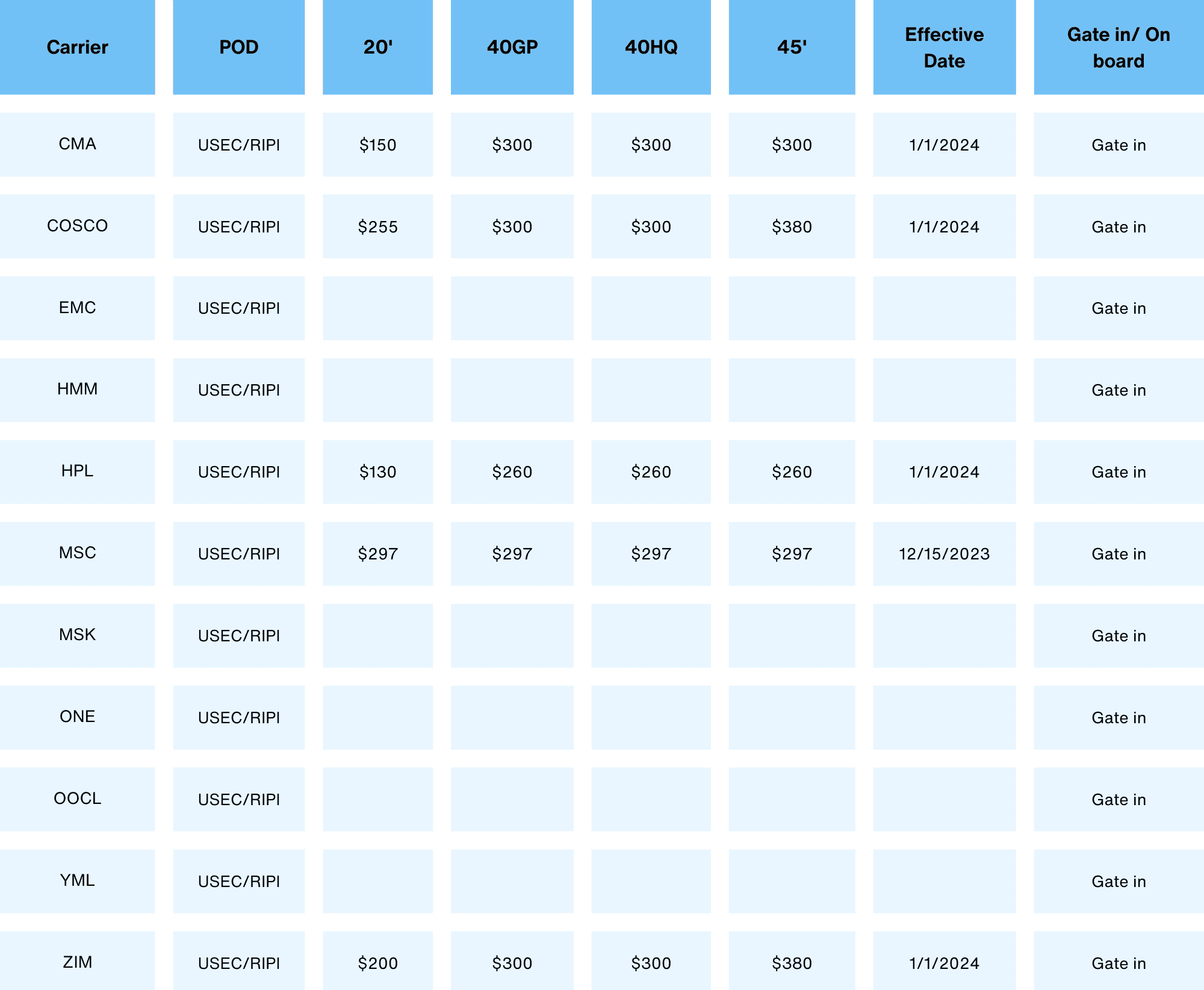
Carriers will implement the Panama Canal Surcharge (PCC) / the Panama Canal Low Water Surcharge (PLW) that will come into effect from December 15, 2023. *** It is important to note that the Panama surcharge will be applied to all containers transiting the Canal, whether it be overweight cargo or light cargo.


Sea Freight

Origin: Asia

Carriers are implementing a new round of GRIs starting from December 15. The announced GRIs are $200 to $300 per FEU for USWC and approximately $600 per FEU for USEC. This will raise new rate levels to $1700 – $1800 for USWC, $2900 – $3000 for USEC, and $3200 – $3300 for GULF in the second half of December. With the effective USEC capacity reduction due to service diversions and an uptick in demand before the Chinese New Year (CNY) starting on February 10, ocean carriers are likely to maintain the mid-December and January 1 GRIs.

Alert!

2/9-2/15 Lunar New Year / Spring Festival 

PLEASE REACH OUT TO OUR TEAM TO PRE-BOOK SPACE AS CARRIERS REMOVE CAPACITY

Need Help Navigating the Current Freight Market? Contact our Procurement Team

In Other News…

  • Logistics companies race to adapt to shifting supply chains – Carriers in ocean, air cargo, rail and trucking are launching new services and tweaking their networks amid evolving global trade flows. – Read More
  • Shipping’s exodus from parched Panama in full flow – The transit backlog at the interoceanic waterway today numbers just 77 ships, 13 below the average since the 2016 expansion of the locks, and down by more than 50 vessels in the space of just a fortnight. For those in the queue, however, wait times are long, especially for ships waiting for a northbound convoy where average wait times topped out at over 15 days earlier this week and currently stand at 14.5 days. – Read More
  • FedEx sends security alert to contractors amid thefts during busy season – FedEx Corp. has sent a security warning to contractors, asking them to give priority to the safety of their drivers and to keep an eye on their vehicles, the Wall Street Journal reported late Thursday, citing a document it viewed. The peak season for deliveries “is showing an increase in unlawful activity, putting increasing concern on safety and security,” according to the alert, which also had a list of safety tips to contractors, the Journal said. Videos of carjackings and thefts from delivery trucks have been posted on social media and aired on television. – Read More
  • Houthis widen ship targets – On Saturday, Yemen’s Houthi movement said they would target all ships heading to Israel, regardless of their nationality, and warned all international shipping companies against dealing with Israeli ports. The Houthis have attacked and seized several Israeli-linked ships in the Red Sea in recent weeks in reaction to the ongoing war in the Gaza Strip. The US has been discussing creating a naval convoy with allies, while also seeking out ways to limit Houthis’ access to cash. – Read More
  • Amazon seller fees target low inventory, inbound transportation costs – The company said the added fulfillment charges will average $0.15 per unit sold once they take effect next year. – Read More

Questions? All you have to do is contact us.

#makingtheworldsmaller

Panama Canal

Experiencing its driest October since 1950 impacting water levels at Lake Gatun—a vital source for the canal and half of Panama. Neo-Panamax draft restriction remains at 44 feet, daily vessel transits reduced to 31, and carriers impose 9-14 ton weight limits. Despite changes, container transit delays are minimal (0.1 days), making Panama Canal the fastest route from Asia to the U.S. East Coast and Gulf Coast. For shipments over 9 tons per 20’ or 16-17 tons for 40’, consider Suez service or, for time-sensitive needs, use the U.S. or Canadian West Coast and rail. CargoTrans monitors the situation and offers transload and intermodal services via the West Coast warehouse.

Carriers will attempt to implement a Dec 1 GRI, however it will be unlikely that it will stick. A GRI from Dec 15 is more likely as we approach Lunar New Year.

2/9-2/15 Lunar New Year / Spring Festival

PLEASE REACH OUT TO OUR TEAM TO PRE-BOOK SPACE AS CARRIERS REMOVE CAPACITY

Share This Post

More Like This

Panama Canal

Starting this November, the Panama Canal Authority will reduce daily transits from 36 to 31, potentially introducing delays of 2-3 days for container services. However, even with these delays, it remains a quicker route for most Asia ports than the Suez Canal. For time-sensitive and heavy cargo, consider alternative routes via the U.S. or Canadian West Coast or explore rail and trucking options.

Market rates are lower than pre-pandemic market as carriers try to implement blank sailing strategy.

Carriers continue to flex their blank sailing muscle to manage capacity and rates. Carrier discipline will determine how effective the Nov GRI is and how long it will stick. Creating artificial demand has not proven to be a successful strategy for the carriers.

TAC Index data shows rates out of China to the US up 6%, and up 4.6% to Europe, in the past month – but, out of Hong Kong, rates grew 14% to North America, and 9.7% to Europe.

Freightos’ FAX shows bigger jumps: rates from South Asia to North America have jumped 12.5% since the start of October; and there was a hefty 21% rise from South Asia to Europe – in the 100kg to 300kg category.

Share This Post

More Like This

Americas


USWC

The West Coast may again be the “best” coast after settling the ILWU contract uncertainty, Panama Canal drought issues, and rate deterioration.

Panama Canal

We are consistently seeing a noticeable increase in transit times  (+ 5-6 days) for vessels passing through the Panama Canal due to weight restrictions.

Sea Freight


Europe → North America

Blank sailing and vessel sliding continue to counter market pricing erosion.

Rates sliding through the end of September and disappearing gains from August triggered carriers of all three alliances to respond with a heavy hand of blank sailings, cutting capacity by 25-50%.


Asia

The launch of iPhone15 and other consumer electronics as well as heavy e-commerce business from SE Asian Countries as well as HK and China, has triggered rate increases across the board.

Need Help Navigating the Current Freight Market? Contact our Procurement Team

In Other News…

  • From 2018-2022 Exports to US from India increased by 44% while China dropped 10% – The International According to BCG’s calculations, the average cost of Indian-made goods imported into the US is 15% lower compared to goods manufactured in the US. In contrast to, Chinese goods offer only 4% cost advantage.
    Read More
  • Aging Cold Storage Capacity at 2.3 million square feet – Cold storage warehousing in the US can’t keep up with growing demand for capacity in the sector, with more than 70% of existing assets too old to be energy efficient and speculative builds deemed too risky given they’re triple the cost of dry warehouses and highly specific to each tenant’s needs.
    Read More
  • Mexico is attractive, but not without its own special trials and tribulations – Mexican officials are trying to stem the flow of migrants headed for the US, which has forced the suspension of some rail operations and truck processing at major border crossings.
    Read More


Questions? All you have to do is contact us.

 

#makingtheworldsmaller

Americas

Canada

Vancouver (BC) This week, members of the International Longshore and Warehouse Union (ILWU) Canada are anticipated to cast their votes on a tentative contract agreement after the terms of the deal have been approved by a union caucus. We are staying close to this so please reach out to your CargoTrans solutions sales or account handler for more details.

Panama Canal

Multiple carriers have announced a Panama Canal Surcharge to go into effect in August in response to the ongoing draft limitations brought on by continuing drought conditions in the region. The market has not accepted this surcharge nor do we anticipate this taking effect this month.

Europe → North America

Market normalization to pre-pandemic rate and service levels

Indian Subcontinent → North America

July blank sailings create environment for acceptance of August GRIs. While carriers may attempt a mid-August GRI we don’t expect any further GRI’s to stick until September.

Need Help Navigating the Current Freight Market? Contact our Procurement Team

Importing into Canada? Are you registered for CARM?

Canada Border Services Agency (CBSA) Assessment and Revenue Management (CARM) project is a multi-year initiative that will transform the collection of duties and taxes for goods imported into Canada.

CARM Timeframe: October 2023

Benefits

CARM will:
• Simplify the overall importing process
• Provide a modern interface for importing into Canada
• Give importers self-service access to their information
• Reduce the cost of importing into Canada
• Improve consistency of compliance with trade rules

Functionalities of the CARM Client Portal will include:
• Electronic commercial accounting declarations with ability for corrections and adjustments
• New requirements related to the Release Prior to Payment (RPP) program
• Harmonized billing cycles

Need Help Navigating this Change? Contact our Customs Team

In Other News…

  • New tentative deal reached in B.C. port strike – The International Longshore and Warehouse Union Canada and B.C. Maritime Employers Association issued a joint statement late Sunday saying a deal has been reached with help from the Canada Industrial Relations Board.
    Read More
  • UPS, union avert strike with planned 5-year deal, more pay – UPS (UPS.N) and its Teamsters union have signed a tentative contract deal for about 340,000 U.S. workers at the parcel delivery firm, one week ahead of a threatened strike that could have cost the economy billions and disrupted a quarter of the nation’s package shipments.
    Read More
  • Teamsters blast bankruptcy-bound Yellow, cite $700 million Covid loan firm got from Trump White House – Bankruptcy-bound trucking firm Yellow received a whopping $700 million in Covid pandemic relief loans three years ago after Trump administration officials pushed for it despite objections from the Defense Department. The Teamsters Union, which represents Yellow workers, blasted the freight carrier in a statement Sunday and highlighted the Covid loans.
    Read More
  • Air India capacity boost may include freighters as export drive accelerates – Tata Group’s revamped Air India is looking at a three-fold increase in cargo handling capacity over the next five years.
    Read More


Questions? All you have to do is contact us.


#makingtheworldsmaller

If at first you don’t succeed, GRI, GRI again!

  • Weaker demand is proving challenging for carriers to gain control of the market.
  • Blank sailings continue to improve vessel utilization, but still not enough for GRI’s to stick.
  • Panama Canal’s low water level triggered strict weight restrictions on east coast bound vessels. Vessels are at near 100% utilization on a tonnage basis, but not on a TEU basis.
  • U.S. ports imported 2,020,197 twenty-foot equivalent units of containerized cargo in April, Descartes said on Monday. That’s down 18% from a year ago, when American importers were frantically shipping in cargo. But it’s up 9% from March and 5% from April 2019, pre-COVID.

In Other News…

  • “So far we don’t see a strong move towards normalization. Some customers are getting to the end of destocking, but it’s not consistent,” Chief Executive Vincent Clerc said in an interview.
  • Progress on the horizon for ILWU: Longshore labor and employers at the ports of Los Angeles and Long Beach have reached agreement on manning requirements for non-automated terminals, overcoming a major hurdle that could accelerate a deal on a new coastwide contract as negotiations near the one-year mark.
  • FMC recognizes actions speak louder than words, beefing up enforcement program with new hire
  • Shippers are choosing quality over race to the bottom pricing in trucking. The wise shipper wants options and recognizes that rates without execution are useless.
  • Going Green: Cost of carbon neutralization for logistics should be excluded from transportation budget and ultimately pushed to the consumer

Asia → North America

(Transpacific East Bound – TPEB)

Capacity: We aren’t seeing any drastic increases in demand on the eastbound trans-Pacific. The market saw continued softness in the week ending 5/12. Expect carriers to continue utilizing blank sailings to tighten market capacity and increase rates

Rates: We’re seeing the market soften a bit and a potential June 1 GRI reported at $1200/$1600 WC/EC is unlikely.
Overheard “carriers are throwing spaghetti at the wall to see what sticks!”

Bottom Line: Carriers still haven’t created market conditions that gives them back control of freight rates. Expect carriers to continue to slow ships down and use blank sailings to drive up utilization and rates.

Europe → North America

(Trans-Atlantic West Bound – TAWB)

Across both North American trade lanes, persistently low volumes and an unbalanced supply/demand balance continues to pose a significant hurdle for carriers.

Capacity: Increased capacity has taken hold of the market. Rates continue to weaken. Industry sources attributed the recent falling rates to overcapacity on the trade, as well as low demand for European goods.

Bottom Line: Rates continue to decline towards pre-pandemic levels on European trade. Perhaps as the Asian market begins to restart we’ll see volumes shift back in peak season. The chase the rate game will continue!

Souteast Asia → North America

Rates and capacity remain static. 

Indian Subcontinent → North America

Capacity: Few blank sailings, limited disruptions, capacity is open.

Rates: Container freight rates from the Indian subcontinent to North America remained stable in the week ended May 12.

Bottom Line: Expect stable rates for the remainder of the month and most likely first half of June.

North American Port Rundown

West Coast

Los Angeles/Long Beach: Port of Los Angeles dwell times for local import cargo is 3.8 days, on-dock rail dwell is 4.3 days and import units on street is averaging at 5.5 / 6.5 days for 20 ft and 40+ ft containers respectively. Cargo container traffic slowed at the Port of Long Beach in April as consumers continued to limit purchases and shippers shuffled trade from the West Coast to seaports on the East and Gulf coasts.

Oakland: Average wait time of up to 2 days at Oakland Int’l Container Terminal (OICT) and 2 days at TraPac. Average import deliveries can take up to 4.7 / 3 days at TraPac and OICT respectively. As yard space becomes available, boxes from TraPac will move to accessible areas for delivering. Average gate turn times are 49 / 56 minutes for OICT and TraPac respectively.

Seattle/Tacoma: No vessel delays. Containers coming off the vessel going into undeliverable areas for approximately 5-7 days. Equipment shortages easing.

Vancouver: Vessel berth congestion has improved, and vessels are no longer waiting to start operations. Daily rail productivity has been improved slightly. Rail dwells is around 8 days (avg.) and expected to getting better. Slight decrease in traffic as volumes have shifted to EC to avoid disruptions from potential strike.

Bottom Line: Low TPEB demand is further keeping West Coast port and rail congestion low. Low risk for WC strike as the current administration will immediately get involved.

East Coast

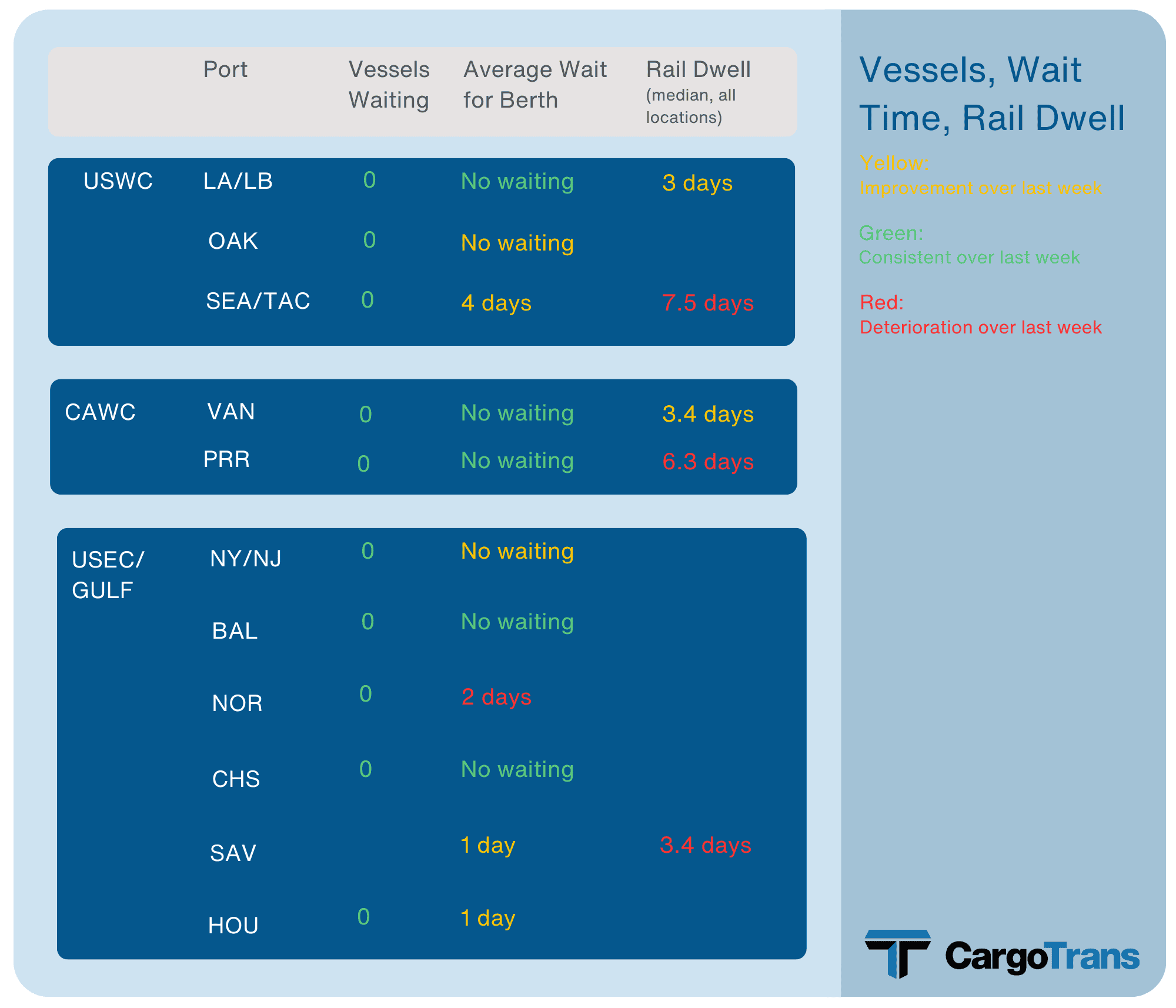
NY/NJ: 1 day waiting time expected for berth at Global Container Terminals Bayonne, Maher Terminals LLC and APM Terminals. No empty shut out situations at any of the terminals this week.

Average gate turn times are 41 / 65 minutes for single and double transactions respectively.
PANYNJ is undertaking projects this year to make it easier for truckers to navigate around the port and decrease waiting times.

Savannah: Maximum wait times of 3 days awaiting berth assignment. Savannah is currently the port with the largest number of ships waiting to berth on the EC, though backlog is getting smaller by about 3 ships per week. Average gate turn times are 38 / 58 minutes for single and double transactions respectively. $1.4 billion investment will increase the port’s annual capacity by 50% to 9 million TEUs, dwarfing other North American port investments planned through at least 2026.

Norfolk: Vessel waiting time is 1 – 2 days of delay for berthing.  One crane is down, no operational impact expected.

Average gate turn times are 28 / 37 minutes for single and double transactions respectively.

Charleston: Waiting time for vessel berthing is up to 2 days.

Houston: Barbours Cut Container Terminal continues to experience berth congestion due to high yard utilization. Waiting time for vessel berthing is up to 3 days. Average gate turn times are 36 minutes at Barbours Cut Container Terminal.

Intermodal Rail

North American intermodal volume continues to lag in 2023, and it isn’t likely to rebound anytime soon.

In the year’s first quarter, total volume fell 8.6% compared to the level in the same quarter in 2022, according   to Intermodal Association of North America (IANA) data. The number of domestic and international containers sank 5.8% and 8.8%, respectively, while trailer volume logged the biggest loss at 28.8%.

All seven high-density trade corridors IANA tracks — which collectively carry 60% of total North American intermodal volumes — posted declines. The south central-southwest corridor logged the biggest deficit at 19.2%.

The decline follows a trend that began last year. Total intermodal volume fell 3.6% year over year in Q4 2022, including a 4.2% drop domestic containers and a 29.7% plunge in trailers, according to IANA.

Domestic Freight Market

Questions? All you have to do is contact us.

 

#makingtheworldsmaller