We fold tariff strategy into your sourcing, supplier, and lane decisions instead of treating duty as a separate problem:
scenario analysis, landed-cost visibility, and real-time monitoring across your whole supply chain.
What Are Tariff Solutions for Supply Chain Leaders?
Tariff solutions for supply chain leaders treat duty as a supply chain variable, not a customs afterthought. The premise is that a tariff decision made in isolation, at the moment of entry, is made too late. The leverage is upstream, in where you source, which supplier you choose, and how you route each lane.
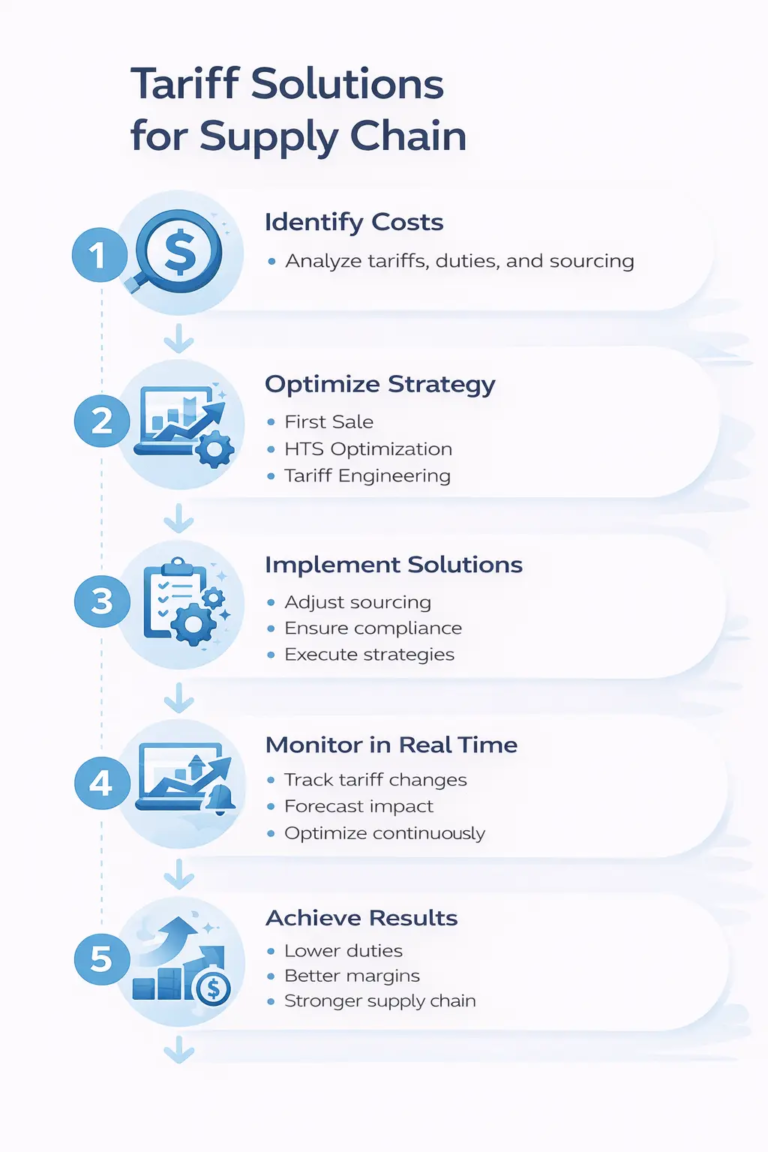
CargoTrans folds tariff strategy into those decisions. Our tariff and trade advisory desk models duty exposure by supplier and country before you commit, so sourcing and tariff strategy are set together. First Sale for Export is positioned as the highest-impact lever, and where it fits we build the First Sale for Export structure into your supplier relationships rather than bolting it on later.
The visibility layer is supply chain optimization software that shows landed cost by lane and monitors tariff changes in real time, so a rate action becomes a sourcing scenario you evaluate, not a bill you absorb. For importers who want the cost angle first, the same program runs through tariff solutions for importers, and every lane connects upstream to international transportation so routing and duty are planned as one.
Landed
cost by lane
Real-time
Tariff monitoring
24h
Response time
Free Strategy Review
Talk to a Supply Chain Advisor
Quick 30-min review of your sourcing and tariff exposure. No obligation.
We reply within 1 business day · Your data stays private.
Capabilities
Our Tariff Solutions for Supply Chain Leaders Capabilities
Six ways our advisors and operators build tariff strategy into the sourcing, supplier, and lane decisions you already own.
01
First Sale for Export Strategy
The highest-impact import cost lever, built into your supplier structure, not added after the fact.
First Sale eligibility evaluation
Supply chain and supplier restructuring
Documentation to defend the lower value
Duty savings modeled before you commit
02
Sourcing and Country Optimization
Choose suppliers and origins with duty exposure priced in, not discovered at entry.
Duty comparison by country of origin
Supplier diversification across regions
Low-tariff sourcing alternatives
03
Scenario Analysis for Sourcing Decisions
Model the landed-cost outcome of each sourcing option before you sign a supplier.
Landed-cost modeling by scenario
Tariff-action impact simulation
Side-by-side supplier comparison
04
Landed-Cost Visibility and Control
See true landed cost by lane and product so tariff exposure is a number you manage.
Landed cost by lane and SKU
Duty visualized by supplier and family
Centralized cost across all lanes
05
Real-Time Tariff Monitoring
Track tariff actions live and turn each one into a proactive sourcing decision.
Tariff and rate-change alerts
Exposure mapped to affected lanes
Data-driven sourcing signals
06
Integrated Platform and Advisory
Strategy and execution in one place, so a sourcing decision becomes a routed, cleared shipment.
Get Started with Tariff Solutions for Supply Chain Leaders
Tariffs are now a top-line cost driver, and the leverage sits upstream in sourcing, not at the customs entry. With landed-cost visibility and scenario analysis, duty becomes a variable you steer.
CargoTrans builds tariff strategy into the supply chain decisions you already make, so margin is protected where it is actually set.
Free 30-minute landed-cost and sourcing exposure review with a supply chain advisor
No-obligation scenario analysis on your highest-duty lanes
First Sale and supplier diversification modeled before you commit
Advisory and licensed execution from one team, not two vendors
A CargoTrans advisor will map your sourcing exposure and model landed-cost scenarios.
Protected by reCAPTCHA. We respond within 1 business day. No spam, ever.
Control Tower
Supply Chain Tariff Visibility, Live Across Every Lane
The Captain Control Tower shows landed cost by lane, supplier, and product family in real time, so tariff exposure is a live number your team steers rather than a year-end surprise.
Configurable alerts flag new tariff actions and shifting duty by origin, and the same feed connects sourcing to multimodal transportation so replenishment and duty are planned as one, not reacted to separately.
Before you commit to a supplier or a country, we model the full landed cost of each option, including duty, so the sourcing decision is made on total cost rather than unit price.
When a tariff action lands, we re-run the scenarios against your live lanes, so you see which suppliers, products, and routes are exposed and where a lawful shift protects the most margin.
What are tariff solutions for supply chain leaders?
Tariff solutions for supply chain leaders treat duty as a supply chain cost driver rather than a customs formality. The core idea is that the biggest tariff leverage is upstream, in where you source, which supplier you choose, and how you route each lane, not at the moment of entry when the cost is already locked in. CargoTrans models duty exposure by supplier and country before you commit, folds levers like First Sale for Export into your supplier structure, and gives you landed-cost visibility across every lane. Real-time monitoring then turns each tariff action into a sourcing scenario you evaluate. The result is tariff strategy that lives inside your sourcing and logistics decisions, so margin is protected where it is actually set instead of defended after the fact.
Why optimize tariffs across the whole supply chain instead of at entry?
Because at the entry, the cost is already committed. Your supplier, your country of origin, your product design, and your routing were all decided upstream, and each of them drives the duty you now owe. Optimizing tariffs only at customs means working with the small margin left after the expensive decisions are locked. When tariffs are considered inside sourcing and supplier selection, you can choose a lower-duty origin, qualify for a trade agreement, or structure a First Sale before the exposure is fixed. Treating duty in isolation also hides trade-offs: a cheaper supplier can carry a higher landed cost once duty is counted. Managing tariffs across the whole supply chain is simply where the leverage actually is, which is the entire premise of this approach.
What is First Sale for Export and why is it the highest-impact lever?
First Sale for Export is a customs valuation rule that lets qualifying importers declare duty on the price of the first sale in the supply chain, the factory-to-middleman price, rather than the higher price you pay the trading company. Because duty is charged on a lower value, the savings can be substantial on high-duty goods, which is why we position it as the highest-impact lever for cutting import cost at the source. Qualifying requires a bona fide sale, arm's length pricing, goods clearly destined for the United States, and complete documentation across invoices, contracts, and proof of payment. We evaluate eligibility, structure the supplier relationships to support it, and build the documentation to defend the lower value, so the saving holds up if CBP reviews it.
How does scenario analysis help sourcing decisions?
Scenario analysis lets you see the full landed-cost outcome of a sourcing decision before you make it. Instead of comparing suppliers on unit price, we model each option with duty, freight, and lawful mitigation included, so the true cost of sourcing from one country versus another is visible side by side. When you are choosing between suppliers, evaluating a new origin, or reacting to a tariff action, the model shows which path protects the most margin. It also stress-tests decisions against change: if a rate rises on a given origin, you already know which alternative wins. That turns sourcing from a price negotiation into a total-cost decision, which is where supply chain leaders find the savings that a customs-only view misses entirely.
What is landed-cost visibility and why does it matter?
Landed cost is the true, all-in cost of getting a product to your door: unit price plus freight, duty, fees, and handling. Many teams manage to unit price because it is the number on the purchase order, but duty and freight can change which supplier or lane is actually cheapest. Landed-cost visibility means seeing that full number by lane, supplier, and product family, in one place, across every broker and forwarder you use. It matters because tariffs move, and without visibility a rate change quietly erodes margin before anyone notices. With it, a tariff action shows up immediately as exposure on specific lanes and products, so you can act on the ones that matter. Visibility is the precondition for managing tariffs as a supply chain cost rather than absorbing them.
How do you build tariff strategy into supplier selection?
We bring duty into the supplier decision at the point it is made, not after. Before you commit, we model each candidate supplier's landed cost, including the duty their country of origin carries and any trade agreement or First Sale structure they could support. A supplier with a lower unit price can lose to one in a lower-tariff country once duty is counted, and that comparison should drive the choice. Where a preferred supplier sits in a high-duty origin, we look at whether First Sale, tariff engineering, or a country shift closes the gap. The output is a supplier selection made on total landed cost with tariff strategy already built in, so you are not renegotiating duty exposure after the relationship and the volumes are locked.
How does supplier diversification reduce duty exposure?
Concentrating your sourcing in one country concentrates your tariff risk there too. If a new duty or trade action hits that origin, your entire exposure moves at once and you have no ready alternative. Diversifying suppliers across regions spreads that risk, so a rate action on one country affects part of your volume rather than all of it, and you can shift toward the lower-duty origin. It also gives you negotiating leverage and resilience against detentions and disruptions, not just duty. We model the landed cost of each region so diversification is driven by total cost and risk, not just by chasing the lowest sticker price. The goal is a sourcing footprint where no single tariff action can compromise your margin or your supply.
How do you keep us ahead of tariff changes?
Tariff policy now changes quickly, so we monitor it in real time and map each change to your actual lanes and suppliers. When a new action lands, the alert tells you not just that a rate moved but which of your products, origins, and shipments are exposed and by how much. From there we re-run your sourcing scenarios, so the response is a modeled decision, shift origin, requalify a trade agreement, or accept the cost, rather than a reaction after the duty is already paid. That keeps your supply chain proactive. Instead of learning about exposure from an invoice, your team sees it as a scenario while there is still time to route around it. Monitoring feeds decisions, which is what separates managing tariffs from merely paying them.
Can you run tariff scenarios across our entire lane and supplier network at once?
Yes. Beyond weighing one supplier against another, we model your full network together, every origin, lane, and product family in a single view, so you see total duty exposure across the supply chain rather than one decision at a time. That portfolio picture shows where risk concentrates: which countries carry the most duty, which lanes would be hit hardest by a new action, and where a shift moves the most margin. When a rate changes, we re-run the whole set against your live shipments and rank the exposures worth acting on first. It also lets you test structural moves, diversifying origins or qualifying First Sale across several suppliers, and see the combined landed-cost effect before committing to any of them. The output is a network-wide model your team can steer, not a stack of one-off comparisons that never add up to a strategy.
Which supply chain teams and industries do you work with?
We work with global importers, retail and e-commerce brands, manufacturers, and enterprise supply chain organizations, the teams for whom duty is a material cost line and sourcing decisions carry tariff consequences. Global importers use us to centralize landed cost and duty across many lanes and brokers. Retail and e-commerce teams use us to protect margin on price-sensitive goods. Manufacturers use us to weigh component sourcing and origin against duty. Enterprise supply chains use us to run scenario analysis across a complex supplier base. The common thread is a leader who treats tariffs as a strategic cost driver to be managed inside sourcing and logistics, not a compliance task to be handed off, and who needs both the strategy and the execution to protect margin.
How is this different from a tariff software tool?
A tariff tool gives you data and alerts, but it does not restructure a supplier, qualify a First Sale program, or route and clear the resulting freight. It shows you exposure. It does not change it. Our model pairs the platform with advisors who design the sourcing and tariff strategy and a licensed team who executes it, so a landed-cost insight becomes an actual supplier shift or a filed duty position. That distinction matters most on the big moves, restructuring for First Sale or diversifying origins, where software can flag the opportunity but only people can implement it. You still get the real-time visibility and scenario modeling a tool provides. You also get the strategy and execution that turn a number on a dashboard into protected margin.
Can you both design the strategy and execute the moves?
Yes, and that combination is the point. We design the strategy, which suppliers and origins to favor, where First Sale fits, how to route each lane, and our licensed customs brokerage and logistics teams execute it, restructuring the supplier relationships and clearing the freight. Advisory-only firms hand you a plan and leave implementation to someone else, which is where strategy and reality drift apart. When the same organization models the scenario and runs the shipment, the landed cost you planned is the landed cost you get, and one team is accountable for the result. You can also engage us for advisory alone if you keep your own execution partners, but the tightest link between a sourcing decision and its outcome comes from having both under one roof.
How long before we see landed-cost savings?
It depends on which lever fits your supply chain. Some savings appear fast: landed-cost visibility and monitoring can expose overpriced lanes and misaligned origins within weeks of connecting your data, and a classification or trade agreement fix can flow through quickly. The larger structural moves take longer because they touch suppliers. Qualifying a First Sale program or diversifying origins requires restructuring relationships and building documentation, which plays out over a sourcing cycle rather than a filing. We sequence it by impact, capturing the quick landed-cost wins and getting monitoring live first, then executing the structural changes that deliver the durable savings. The gate is usually supplier readiness and data quality, so the assessment front-loads both to keep the timeline moving.
How do rising tariffs threaten our margins and pricing?
Rising tariffs hit margin directly, because duty is a cost you often cannot pass through without losing price competitiveness. If your sourcing is concentrated in a country that draws a new tariff, your whole landed cost jumps at once, and in price-sensitive categories you either absorb it and lose margin or raise prices and lose volume. The threat compounds when you lack visibility, since the erosion is invisible until it shows up in the numbers. Managing tariffs across the supply chain is the defense: diversify origins so no single action moves all your cost, use First Sale and trade agreements to lower the duty base, and model exposure continuously so you act before margin is lost. The goal is to keep competitive pricing in global markets while protecting the margin behind it.