Move beyond transactional clearance and give your clients strategy —
First Sale, HTS optimization, and real-time tariff intelligence you deliver as value-added advisory, layered onto the filings you already run.
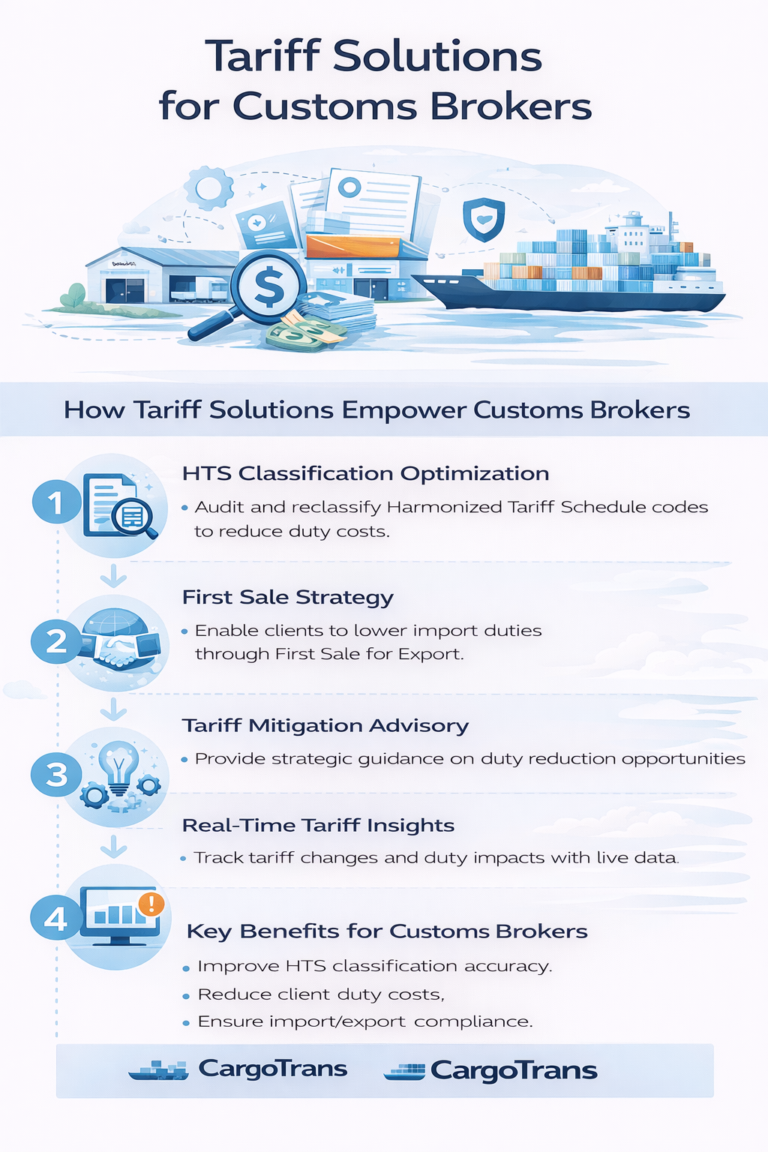
Tariff solutions for customs brokers are the strategy and intelligence a broker layers onto routine clearance so clients get cost savings, not just cleared entries. Instead of competing on filing speed and price alone, you deliver First Sale, HTS classification optimization, and real-time tariff intelligence as advisory work your clients will pay a premium for.
CargoTrans supplies the engine behind that shift, combining tariff and trade advisory depth with the Tariff Tracker, so the insights you resell are backed by measurable duty numbers rather than a generic tool.
The model is deliberately additive. It integrates with your existing brokerage systems and workflows rather than replacing them, and it does not compete with your role as the licensed customs broker of record. You keep the client relationship and the filings; we give you the advisory capability to grow their value and yours.
10-30%
Client duty cut
5-step
Broker method
24h
Response time
Free Broker Review
Talk to a Partnership Lead
Quick 30-min review of your advisory opportunity. No obligation.
We reply within 1 business day · Your data stays private.
Capabilities
Our Tariff Solutions for Customs Brokers
Six ways brokers turn transactional clearance into value-added advisory their clients pay for.
01
First Sale as a Reseller Service
Offer your importer clients the single biggest duty-reduction lever, delivered under your relationship.
First Sale eligibility screening for clients
Supply chain and documentation support
10 to 30 percent duty savings you deliver
A differentiator competing brokers lack
02
HTS Classification Optimization
Reduce your clients' classification errors and duty overpayments, and reduce your own liability.
Classification review across client catalogs
Correction of costly misclassifications
Duty rate comparison and validation
03
Advisory + Execution Model
Deliver cost-saving insight and the implementation to capture it, not just a recommendation.
Insight paired with hands-on execution
Strategy tied to measurable duty results
Delivered under your client relationship
04
Real-Time Tariff Intelligence
Layer monitoring, forecasting, and scenario planning onto the filings you already run.
Live monitoring of tariff and rate changes
Forecasting and scenario planning
Insights you push to clients proactively
05
Scale Across Clients and Lanes
Apply the same advisory playbook across many clients, shipments, and trade lanes.
Repeatable across your whole book
Consistent across shipments and lanes
Advisory that grows with your volume
06
Integration with Your Brokerage Systems
Works inside your existing systems and workflows instead of forcing a platform change.
Why Partner with CargoTrans on Tariff Solutions for Customs Brokers?
You resell measurable results, not just a piece of software, so clients see duty savings they can quantify rather than another tool license they have to figure out.
The model is additive and white-label, so it integrates with your existing brokerage systems and is delivered under your brand and your client relationship.
First Sale becomes a service you own, so you differentiate from competing brokers who can only file entries rather than reduce what clients pay.
Advisory and execution come together, so you move from a transactional provider clients shop on price to a strategic partner they cannot easily replace.
Our Process
How Our Tariff Solutions for Customs Brokers Work
01
Broker Assessment
Review your client book, trade lanes, and advisory opportunity.
02
Opportunity Identification
Find First Sale and reclassification wins across your clients.
03
Solution Design
Package the advisory offer under your brand and pricing.
04
Client Rollout
Deliver the insight and execute it against real filings.
05
Continuous Optimization
Monitor tariffs and grow the advisory across your book.
A CargoTrans partnership lead will map your advisory opportunity and how to package it for clients.
Protected by reCAPTCHA. We respond within 1 business day. No spam, ever.
Control Tower
Real-Time Tariff Intelligence for Brokers
The intelligence layer watches tariff and rate changes as they happen and translates them into what they mean for each client's product mix, so you can push a heads-up before an entry files instead of explaining a surprise after it does.
That same monitoring makes strategic services easy to introduce, so a client flagged as a strong candidate for first sale for export becomes a proactive advisory conversation rather than a missed opportunity.
Every position you deliver to a client, from a First Sale valuation to a reclassification, is backed by documentation built as the work happens, so the reasonable care file protects both your client and your brokerage if CBP asks.
Where a client needs deeper strategy work, our customs consulting team backs you up, so you can say yes to advisory requests that used to be outside your scope.
Tariff solutions for customs brokers are the advisory services and intelligence a broker layers on top of routine clearance so clients receive cost savings, not just cleared entries. They include First Sale as a resellable service, HTS classification optimization, and real-time tariff intelligence you deliver as value-added advisory. The point is to move your brokerage from a transactional provider competing on filing price to a strategic partner that reduces what clients pay in duty. CargoTrans supplies the engine, the advisory depth, the documentation, and the tariff data, while you keep the client relationship and the filings. It is designed to integrate with your existing systems and be delivered under your brand, so it grows your book rather than competing with it.
How can a customs broker resell First Sale to clients?
First Sale is the strongest example of a service you can package and resell, because it is high-value, most importers do not know they qualify, and competing brokers rarely offer it. You screen your client book for candidates, importers who buy through a trading company or middleman, and present First Sale as your advisory offering. We provide the eligibility evaluation, the supply-chain and documentation support, and the execution behind the scenes, delivered under your relationship. The client sees their broker cutting their duty by 10 to 30 percent, which is a very different conversation from filing an entry. Because it is documented and defensible, it deepens trust rather than exposing you to risk, and it becomes a reason clients stay with you instead of shopping on price.
Will this compete with my brokerage or replace my filings?
No. The model is deliberately additive. It integrates with your existing brokerage systems and workflows rather than replacing them, and it does not touch your role as the licensed customs broker of record. You keep the filings, the client relationship, and the billing. What we add is the advisory capability that sits on top: the strategy, the tariff intelligence, and the documentation depth that most brokerages cannot staff on their own. Think of it as a white-label engine behind your brand rather than a competitor for your clients. The goal is to make your existing clearance business stickier and more valuable, not to insert another party between you and the importer you already serve.
How does this help me move from transactional to strategic advisor?
Transactional clearance is a commodity, and commodities are bought on price, which is why brokers get squeezed at renewal. The way out is to deliver something a spreadsheet-driven competitor cannot: measurable duty savings and forward-looking tariff strategy. When you bring a client a First Sale opportunity, a reclassification that lowers their rate, or a heads-up on a tariff change before it hits their entries, you stop being the vendor who files paperwork and become the advisor who protects their margin. That changes the relationship and the pricing conversation. This program gives you the strategies, the execution, and the intelligence to make that shift without hiring a trade-advisory team of your own or building the technology from scratch.
What is HTS classification optimization and how does it help my clients?
HTS classification optimization is the review and correction of the tariff codes assigned to your clients' products. Misclassification is common, and a good sitting in a higher-duty code than it belongs in means the client overpays on every entry, sometimes for years. We audit classifications across a client's catalog, compare duty rates across the codes a product could reasonably fall under, and correct the ones that are wrong, with documentation of the technical basis. For your clients that means lower duty and less audit exposure. For your brokerage it means fewer classification errors on your filings and less liability, plus a concrete, quantifiable win you can show a client. It is one of the easiest advisory services to introduce because the savings are immediate and defensible.
What is real-time tariff intelligence and how do I layer it onto filings?
Real-time tariff intelligence is continuous monitoring of tariff actions, rate changes, and regulatory shifts, translated into what they mean for each client's specific product mix. Rather than reading about a new tariff and manually working out who it affects, you get the impact mapped to your clients automatically, plus forecasting and scenario planning so you can advise before entries file. You layer it onto your existing filings through integration, so the intelligence rides alongside the work you already do rather than living in a separate tool nobody checks. The practical effect is that you can reach out to a client proactively, warning them about exposure or flagging a savings opportunity, which is exactly the kind of forward-looking service that distinguishes an advisor from a filer.
How is this different from just buying tariff software?
A standalone tariff tool gives your clients, or you, a screen and leaves the work to them. This program delivers measurable results, because advisory and execution come with it. Software can flag that a duty rate changed; it does not evaluate First Sale eligibility, restructure documentation, correct a classification, or defend the position under audit. Those require people who know trade law and are accountable for the outcome. For a broker, that distinction matters commercially: reselling a tool subscription is a thin, replaceable offering, while reselling quantified duty savings backed by a team is a genuine differentiator. We pair the tariff data and intelligence with the advisory and execution muscle, so what you bring to clients is an outcome, not a login.
Does it scale across many clients and trade lanes?
Yes, scalability is central to the design. The same advisory playbook, First Sale screening, classification review, and tariff monitoring, applies across your entire book, so you are not reinventing the approach for each client. It works consistently across different shipments and trade lanes, which is important because a broker's value is in handling volume and variety efficiently. As your book grows, the advisory grows with it rather than becoming a bottleneck, because the intelligence and execution capacity scale behind your brand. That lets you offer strategic services to more than just your largest accounts, extending advisory down into mid-sized clients who would never justify a dedicated trade-advisory hire but still generate meaningful duty savings when the playbook is applied.
What does the advisory plus execution model mean for a broker?
It means you deliver both the insight and the implementation, not just a recommendation a client has to act on alone. Many advisory offerings stop at identifying an opportunity, which leaves the client with a report and no result. Here, when we identify that a client qualifies for First Sale or that a product is misclassified, the same engagement carries it through to execution against real filings, with the documentation to defend it. For your brokerage that is the difference between selling advice and selling outcomes. Clients pay more for outcomes and stay longer because the value is realized, not theoretical. It also protects you, since the positions taken are documented and defensible rather than a suggestion the client implemented incorrectly on their own.
Does it integrate with my existing brokerage systems?
Yes. The program is built to work inside your current brokerage systems and workflows rather than forcing a rip-and-replace. The intelligence and advisory layer connects to the tools you already run, so entries, client data, and product information flow without you re-platforming your operation. That keeps adoption low-friction and means your team is not learning an entirely new system to deliver the advisory services. It is also white-label, so what reaches your clients carries your brand, not ours. The intent is to be the engine behind your brokerage, invisible to the client and additive to your stack, so you gain advisory capability without disrupting the clearance operation that already runs your business.
What is the 5-step method for brokers?
The program runs in five stages built around your brokerage. First, Broker Assessment reviews your client book, trade lanes, and where the advisory opportunity is largest. Second, Opportunity Identification finds the specific wins, First Sale candidates and reclassification savings, across your clients. Third, Solution Design packages the advisory offer under your brand and your pricing, so it is genuinely yours to sell. Fourth, Client Rollout delivers the insight to clients and executes it against real filings. Fifth, Continuous Optimization monitors tariff changes and expands the advisory across more of your book over time. The structure starts with your business rather than a single shipment, because the goal is to build a repeatable advisory line for your brokerage, not to run a one-off project for one client.
Which brokers benefit most from these solutions?
The strongest fit is high-volume brokers with a large book to apply the playbook across, and brokers serving importers who carry meaningful duty in high-tariff categories where savings are material. Compliance-focused brokers benefit because classification optimization and documented positions reduce their own liability while helping clients. Growth-oriented firms that want to differentiate from price-competing rivals get the clearest strategic payoff, since advisory is exactly what lets them escape the commodity trap. Brokers whose clients are already asking about tariff mitigation, and who currently have to refer that work out or decline it, gain the ability to say yes. The assessment identifies where the opportunity is real in your specific book rather than assuming every brokerage will monetize it the same way.
Is the service white-labeled to my brokerage?
Yes. What reaches your clients is delivered under your brand and your relationship, not ours. We operate as the engine behind the scenes, supplying the advisory depth, the tariff intelligence, and the execution, while you remain the face of the service and the point of contact for the client. That protects the relationship you have built and lets you present tariff advisory as a natural extension of your brokerage rather than an outside referral. Pricing, packaging, and client communication stay in your hands. The white-label structure is deliberate, because the whole point is to strengthen your position with your clients, which only works if the value is clearly attributed to you rather than to a third party the client could go to directly.
How do I get started as a broker partner?
It begins with a free 30-minute broker advisory assessment. We look at your client book, your trade lanes, and where the largest tariff-savings opportunities sit, then show you which services, First Sale, classification optimization, tariff intelligence, would resell best to your clients and roughly what they are worth. From there we design the packaging under your brand and pricing, and agree how execution and support work behind the scenes. Because the model is additive and white-label, onboarding does not disrupt your existing clearance operation, and you can start with a single client or a pilot segment before rolling it across your book. The assessment carries no obligation, so you can see the opportunity quantified before committing to a partnership.