We help importers stop overpaying duty and defend their margins from rising tariffs —
First Sale, HTS optimization, FTA and FTZ strategy, and duty drawback run as one program with live landed-cost visibility.
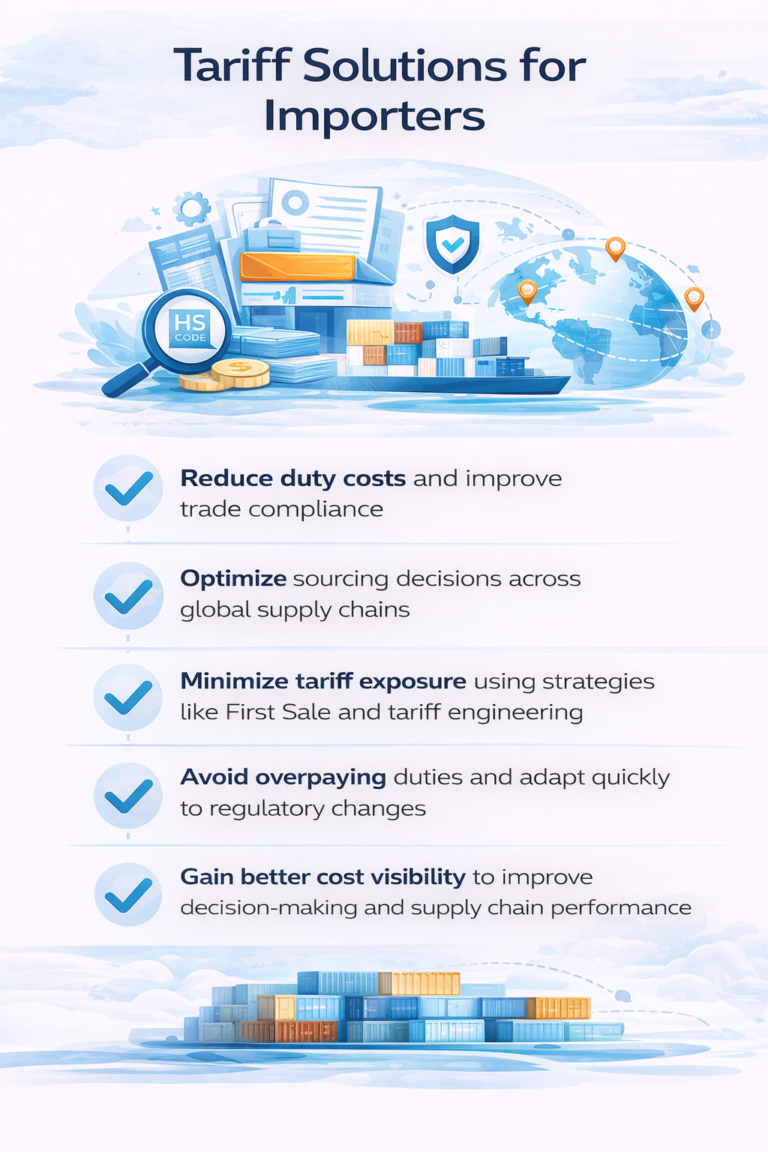
Tariff solutions for importers are the strategies that lower the duty you pay on goods you bring into the United States: First Sale valuation, HTS optimization, tariff engineering, sourcing diversification, duty drawback, and Free Trade Agreement and Foreign Trade Zone planning. Together they turn landed cost from a fixed burden into a number you can actively manage.
CargoTrans delivers these as one program that combines advisory and execution, backed by tariff and trade advisory depth and surfaced through the Tariff Tracker, so every recommendation traces to a duty number rather than a guess.
For most importers the headline lever is first sale for export, which can cut duty by 10 to 30 percent when you buy through a trading company or middleman. Around it we layer reclassification, origin diversification, and recovery so the savings stack, and live Control Tower visibility keeps landed cost in view as tariffs change.
10-30%
First Sale duty cut
5-step
Import method
24h
Response time
Free Import Review
Talk to a Tariff Advisor
Quick 30-min review of your import duty. No obligation.
We reply within 1 business day · Your data stays private.
Capabilities
Our Tariff Solutions for Importers
Six levers our advisors run so importers stop overpaying duty and protect their margins.
01
First Sale Strategy
The single biggest duty-reduction lever for importers who buy through a trading company or middleman.
First Sale eligibility evaluation
Supply chain and pricing restructuring
Bona fide sale and arm's length documentation
10 to 30 percent duty reduction potential
02
Tariff Engineering
Adjust product design or materials so goods fall into a lower-duty classification, modeled before you commit.
Product design and material review
Reclassification into lower-duty categories
Duty impact modeled before changes
03
HTS Code Optimization
Audit and correct the classifications that quietly overcharge you on every entry.
Classification audit across your catalog
Correction of costly misclassifications
Duty rate comparison and validation
04
Sourcing and Country Optimization
Diversify origin to lower-tariff countries and weigh suppliers on total landed cost, not unit price.
Origin diversification to low-tariff countries
Landed-cost comparison by source
Supplier scenario analysis
05
Duty Drawback Programs
Recover duty already paid on goods you subsequently export or destroy.
Recovery of duty on exported goods
Manufacturing and unused-merchandise drawback
Refund claim filing and support
06
FTA Utilization and FTZ Strategy
Qualify goods under trade agreements and defer or eliminate duty through zone entry.
Why Choose CargoTrans Tariff Solutions for Importers?
First Sale is treated as your headline lever, not an afterthought, because for importers buying through a middleman it is the single largest duty-reduction opportunity available.
Advisory and execution live in one team, so a strategy we recommend is also one we implement against your real filings, not a report you have to action alone.
Sourcing decisions weigh duty as a real landed cost, so origin diversification is evaluated on total delivered cost rather than unit price alone.
Live Control Tower visibility keeps landed cost in view, so new tariff exposure is caught and priced before it quietly erodes your margins.
Our Process
How Our Tariff Solutions for Importers Work
01
Import Assessment
Map your imports, HTS codes, suppliers, and duty baseline.
02
Opportunity Identification
Find First Sale, drawback, FTA, and reclassification savings.
03
Strategy Design
Design the plan and the documentation to support it.
04
Execution
Implement against your filings and recover eligible duty.
Rising duties do not have to eat your margins. With First Sale, HTS optimization, and smarter sourcing, landed cost becomes a number you can actively manage.
CargoTrans pairs advisory strategy with execution so the savings are real, defensible, and continuous.
Free 30-minute import tariff review with an advisor
First Sale eligibility evaluation for your supply chain
Duty drawback recovery on goods you export
Live landed-cost visibility through the Control Tower
A CargoTrans advisor will map your import duty and quantify the savings available.
Protected by reCAPTCHA. We respond within 1 business day. No spam, ever.
Control Tower
Live Tariff Visibility for Importers
Cutting duty starts with seeing it. The Control Tower gives importers a live view of duty spend by HTS code, supplier, and product family, so the classifications and lanes carrying your heaviest tariff load are obvious rather than buried in entry summaries.
That same visibility surfaces recovery opportunities, so goods you import and later export can be flagged for duty drawback instead of leaving refundable duty on the table.
Every duty-saving position, from a First Sale valuation to an FTA claim, is only as strong as the paperwork behind it. Our advisors build the commercial invoices, contracts, and proof-of-payment trail as the strategy is implemented, so your reasonable care file holds up if CBP asks.
For importers carrying high-duty catalogs, we combine that documentation discipline with customs duty reduction consulting so the savings are both aggressive and defensible.
Tariff solutions for importers are the set of strategies that lower the duty you pay on imported goods and protect your margins from rising tariffs. They include First Sale valuation, HTS code optimization, tariff engineering, sourcing and country diversification, duty drawback, and Free Trade Agreement and Foreign Trade Zone planning. Individually each addresses a different part of your landed cost; together they compound. For most importers the largest single lever is First Sale, which lowers the value duty is calculated on. CargoTrans delivers these not as a report but as a program that pairs advisory with execution, so a recommended strategy is also implemented against your real filings and monitored through the Control Tower as tariffs and sourcing change.
Is First Sale really the biggest lever for importers?
For importers who buy through a trading company or middleman, yes, First Sale is typically the single largest duty-reduction opportunity. The First Sale for Export rule lets duty be assessed on the earlier factory-to-middleman price rather than the higher price you pay the middleman, which can cut the dutiable value by 10 to 30 percent. Because duty is a percentage of that value, lowering the basis lowers duty on every future entry, not just once. It does require a genuine multi-tier transaction, arm's length pricing, and documentation proving the goods were destined for the United States. Where those conditions hold, no other lever moves as much duty for as many importers, which is why we evaluate eligibility first.
How do I know if my imports qualify for First Sale?
Qualification turns on the structure of your purchase, not the product. You generally need at least two genuine sales in the supply chain, for example a manufacturer selling to a trading company and the trading company selling to you, each a bona fide sale at arm's length pricing. The goods must be clearly destined for the United States at the time of the first sale, and you must be able to document it with commercial invoices, purchase orders, contracts, proof of payment, and production records. Our advisors run an eligibility evaluation against your actual transaction flow before you commit, so you know whether the structure supports it and what documentation you would need to defend the position under CBP review.
What is tariff engineering and can it lower my duties?
Tariff engineering is the practice of designing or adjusting a product so it legitimately falls into a lower-duty classification. Small, deliberate changes to materials, composition, function, or how an item is imported can move it from a high-duty HTS code to a lower one. A classic example is importing a component or an unfinished good that carries a lower rate than the finished article. The key word is legitimate: the product must genuinely meet the classification claimed, which is why we model the duty impact and validate the classification before any change is made. For importers with large volumes in high-duty categories, engineering a single high-runner SKU into a better code can save meaningful duty on every future shipment.
How does HTS reclassification reduce what I pay?
Your duty rate is set by the Harmonized Tariff Schedule code assigned to each product, and misclassification is common, especially across large catalogs loaded years ago. If a good is sitting in a higher-duty code than it correctly belongs in, you overpay on every entry until it is fixed. We audit your classifications, compare duty rates across the codes a product could reasonably fall under, and correct the ones that are wrong. Reclassification has to be defensible, so we document the technical basis rather than simply picking the cheapest code. The savings vary by catalog, but for importers who have never had classifications reviewed, correcting even a handful of high-volume SKUs often returns more than the cost of the review.
Can changing where I source from reduce tariffs?
Yes. Duty rates depend heavily on country of origin, so where you source can matter as much as what you source. Goods from a country covered by a Free Trade Agreement may enter at a reduced or zero rate, while goods from a country subject to additional tariffs carry a premium. Sourcing and country optimization means evaluating alternative origins on total landed cost, including duty, freight, and lead time, rather than unit price alone. We run supplier scenario analysis so you can see the delivered-cost difference before shifting volume. Diversifying origin also reduces concentration risk if new tariffs hit a single country, which is increasingly a reason importers restructure their supplier base rather than a nice-to-have.
What is duty drawback and how much can I recover?
Duty drawback is a refund of duties, taxes, and certain fees you paid on imported goods that are later exported or destroyed, or used to make something that is exported. Depending on the program, you can recover up to 99 percent of the eligible duty paid. There are several types, including manufacturing drawback and unused-merchandise drawback, and claims can often reach back several years, so there may be recoverable duty on shipments you have already made. The catch is documentation: you have to trace imported goods to their export, which is where many importers leave money on the table. We identify eligible flows, file the claims, and support the substantiation so the refund actually lands.
How do FTAs and FTZs help importers?
Free Trade Agreements and Foreign Trade Zones attack duty from two different angles. An FTA can reduce or eliminate duty on goods that meet the agreement's rules of origin, so qualifying your products correctly can zero out a rate you are currently paying. A Foreign Trade Zone lets you hold, manipulate, or manufacture goods inside a designated zone without paying duty until they enter U.S. commerce, and goods re-exported from the zone can avoid duty entirely. FTZs also allow inverted-tariff benefits where a finished good carries a lower rate than its components. We assess which of your products qualify under an FTA and whether your volume and flow justify FTZ treatment, then handle the origin analysis and entries.
How much can importers realistically save?
It depends on your product mix, sourcing, and how your transactions are structured, so an honest answer requires looking at your actual entries. That said, the ranges are meaningful: First Sale commonly cuts duty 10 to 30 percent for eligible importers, drawback can recover up to 99 percent of duty on exported goods, and reclassification or engineering can permanently lower the rate on high-volume SKUs. Savings stack because the levers address different parts of landed cost. Rather than promise a headline number, we start with an assessment that quantifies the opportunity across all the levers, so you see the expected savings before committing. For high-volume importers in high-duty categories, the combined effect is often the largest single margin improvement available.
Do these tariff solutions require me to change freight forwarders?
No. The advisory and execution work sits on top of whatever forwarders and brokers you already use, and the Control Tower centralizes your customs data regardless of who filed the entry. Switching forwarders is disruptive and is rarely where tariff savings come from, so we do not make it a precondition. What matters is visibility into your duty data and the strategy applied to it, both of which we can layer onto your existing flow. If you later choose to consolidate freight with us, that is a separate decision driven by service and cost, not a requirement to capture the duty savings on this page. The two are deliberately kept independent.
What is the 5-step method for importers?
The program runs in five stages. First, Import Assessment maps your imports, HTS codes, suppliers, and current duty baseline so we know what you actually pay. Second, Opportunity Identification finds the applicable levers, First Sale, drawback, FTA qualification, reclassification, and ranks them by dollar impact. Third, Strategy Design builds the plan and, critically, the documentation needed to defend each position. Fourth, Execution implements the strategies against your real filings and files any recovery claims. Fifth, Continuous Optimization monitors landed cost and adjusts as tariffs, sourcing, and your catalog change. The structure matters because tariff savings are not a one-time project; new exposure appears with every tariff action and every new SKU, so the last step is ongoing rather than a finish line.
Which importers benefit most from these solutions?
The clearest fit is mid-market to high-volume importers with enough duty spend that a percentage improvement is material, particularly in high-duty categories like apparel, footwear, consumer electronics, automotive components, and industrial equipment. Retail and e-commerce importers benefit from reclassification and origin work across broad catalogs. Manufacturers benefit from tariff engineering and drawback tied to exported finished goods. Importers who buy through trading companies are prime First Sale candidates. Growing businesses that have never had their tariffs reviewed often carry the most low-hanging fruit, since classifications and structures set up years ago are rarely optimized. The assessment tells you honestly whether the opportunity justifies the effort, rather than assuming every importer will see the same result.
How do you keep my duty savings defensible in an audit?
Aggressive duty savings are worthless if they collapse under CBP review, so documentation is built into the work rather than added afterward. For a First Sale position we assemble the commercial invoices, purchase orders, contracts, proof of payment, and production records that prove a bona fide sale at arm's length destined for the United States. For reclassification we document the technical basis for the code. For FTA claims we keep the origin substantiation. Everything is logged as the strategy is implemented, so your reasonable care file exists in real time. Because the same team advises and executes, the people who took the position are the ones who defend it, not an outside firm reconstructing a rationale months later under audit pressure.
How do I get started and what does it cost?
It starts with a free 30-minute import tariff review. We look at your imports, HTS codes, suppliers, and duty baseline and give you an honest read on which levers apply and roughly what they are worth, including a First Sale eligibility check for your supply chain. From there, engagement scope and cost track the opportunity: a targeted project such as a single reclassification or a First Sale implementation is priced by the task, while a continuous optimization program is scoped to your volume. Recovery work like drawback is often structured so the fee follows the refund. We would rather size the engagement to real savings than sell a generic retainer, which is why the assessment comes first and carries no obligation.