We map your import and export program against the rules, automate the documentation, and cut duty exposure at the same time:
audits, process automation, and real-time monitoring run by advisors who also execute the filings.
What Do Tariff Solutions for Trade Compliance Cover?
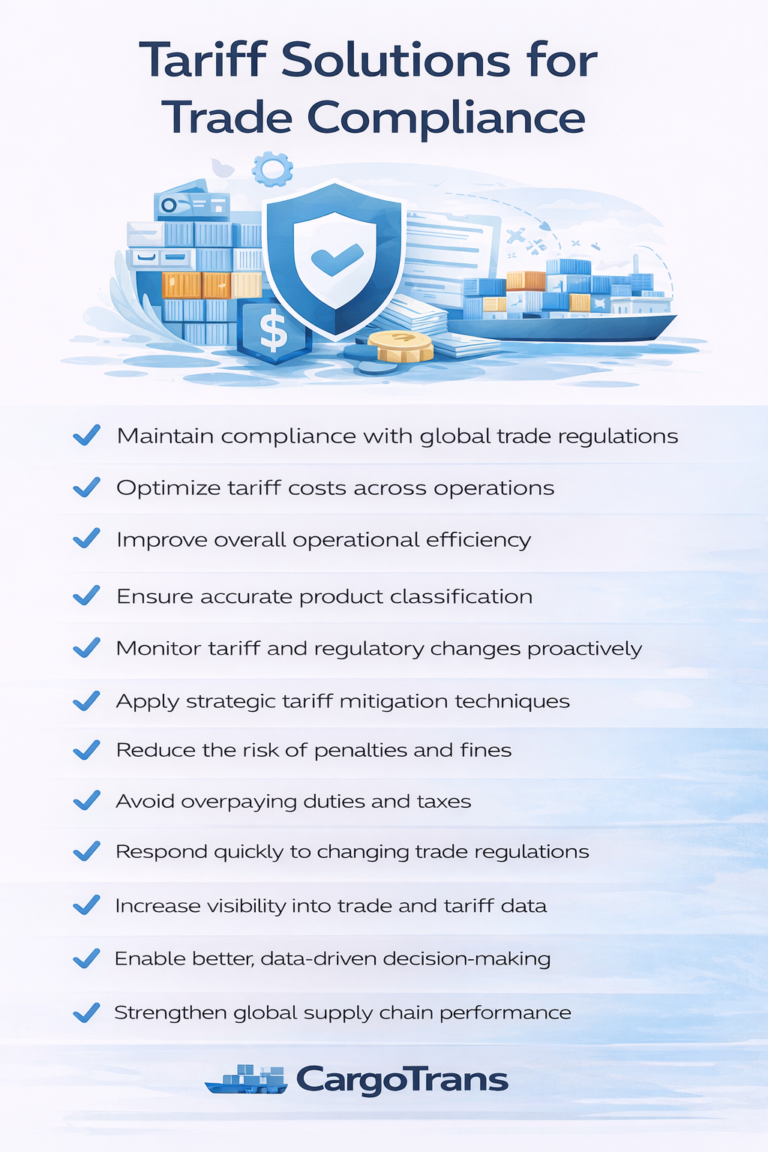
Tariff solutions for trade compliance combine the duty-savings work of tariff strategy with the discipline of a documented, audit-ready import and export program, so cutting cost and passing enforcement stop being a trade-off and become one project.
CargoTrans pairs a tariff and trade advisory desk with the operators who file your entries, so classification, valuation, and country-of-origin decisions are made once and documented the same way every time. The same team stands up a trade compliance program around those decisions, standardizing workflows and building the reasonable-care file as goods move.
The engine underneath is Captain trade compliance software, which posts tariff and regulatory changes in real time and flags entries that fall outside your own rules. Where a duty-reduction lever needs execution, our licensed customs brokerage desk files it, and broader savings programs run through customs duty reduction consulting without a handoff to an outside firm.
1 desk
Advisory + execution
Real-time
Regulatory monitoring
24h
Response time
Free Compliance Review
Talk to a Trade Compliance Advisor
Quick 30-min review of your import and export exposure. No obligation.
We reply within 1 business day · Your data stays private.
Capabilities
Our Tariff Solutions for Trade Compliance Capabilities
Six things our advisors and operators run so your trade program stays audit-ready while your duty bill goes down.
01
Trade Compliance Audits
Import and export reviews that test your classifications, valuations, and documentation before CBP does.
Import and export compliance reviews
Documentation and recordkeeping audits
Process standardization across entries
Gap findings ranked by penalty exposure
02
Documentation and Process Optimization
Standardized workflows that turn one-off filings into a repeatable, defensible process.
Standardized entry and export workflows
Reasonable-care recordkeeping built in
Reduced manual data-entry errors
03
Compliance Process Automation
Rules and checks that run automatically so exceptions surface before an entry files wrong.
Automated classification validation
Exception flags on out-of-rule entries
Audit trail captured as goods move
04
Real-Time Tariff and Regulatory Monitoring
Live tracking of tariff actions and rule changes so enforcement shifts never surprise you.
Tariff action and rate-change alerts
Regulatory and enforcement updates
Scenario flags on affected entries
05
Duty Optimization Within Compliance
Every lawful cost-reduction lever, applied inside a documented compliance framework, not around it.
Classification and valuation review
FTA and duty-deferral eligibility
First Sale and drawback screening
06
ERP, TMS and Platform Integration
Connects to the systems you already run so compliance data lives where your team works.
Why Choose CargoTrans for Trade Compliance Tariff Solutions?
Advice and execution live in one team, so a classification decision your advisor recommends is filed the same way by the desk that clears your freight, with no gap between strategy and entry.
Compliance and cost reduction are pursued together, so you get audit-ready documentation and a lower duty bill instead of choosing between them.
Tariff and regulatory changes are monitored in real time, so an enforcement shift reaches your team as an alert on affected entries, not as a detention notice.
The reasonable-care file is built as goods move and logged against the customs record, so an audit is answered from evidence you already hold, not reconstructed under deadline.
Our Process
How Our Trade Compliance Tariff Process Works
01
Compliance Assessment
Review your entries, documentation, and processes for risk and duty exposure.
02
Gap and Opportunity Mapping
Rank compliance gaps by penalty risk and flag every lawful saving.
03
Program and Process Design
Standardize workflows and automate the checks that keep entries in the rules.
04
Execution and Filing
Apply classifications, valuations, and duty levers through our brokerage desk.
05
Monitor and Audit
Track tariff and rule changes and keep the audit-ready file current each month.
Get Started with Tariff Solutions for Trade Compliance
Compliance should not be the price you pay for savings. With audited entries, automated checks, and a documented process, you lower duty and lower risk at the same time.
CargoTrans turns trade compliance from an annual fire drill into a controlled, measured program.
Free 30-minute compliance and duty-exposure review with a trade advisor
No-obligation audit-readiness assessment of your entries and documentation
Advisory and licensed execution from one team, not two vendors
Integration support from ERP and TMS to entry filing
A CargoTrans trade advisor will review your exposure and map audit-readiness and savings.
Protected by reCAPTCHA. We respond within 1 business day. No spam, ever.
Control Tower
Trade Compliance Tariff Monitoring, Live From Every Entry
The Captain Control Tower posts each classification, valuation, and duty event as it files, so your compliance position is visible in real time instead of at year-end review.
Configurable alerts flag out-of-rule entries, expiring FTA claims, and new tariff actions early, and the same feed connects compliance to First Sale for Export screening so lawful savings are planned, not missed.
Audit-Ready Trade Compliance Records, Built as You File
Every classification, valuation basis, and origin determination is logged against the customs record as the entry files, so your reasonable-care file is complete before an audit is ever announced.
Because the advisors who set the rules also run the filings, an entry correction or a CBP inquiry is answered by the team that made the decision, not routed to a firm that never touched your program.
Tariff solutions for trade compliance combine two things importers usually buy separately: a strategy that lowers your duty bill and a documented, audit-ready program that keeps you inside the rules. The idea is that compliance and cost control are not a trade-off. CargoTrans reviews your classifications, valuations, and country-of-origin decisions for both risk and savings, standardizes the documentation behind them, and monitors tariff and regulatory changes so nothing drifts out of compliance. The advisory desk that recommends a change and the licensed team that files it are the same organization, so the strategy on paper matches the entry that clears CBP. The result is a program that passes enforcement scrutiny and pays for itself through lawful duty reduction.
How do you achieve compliance and cost savings at the same time?
By treating them as the same project rather than competing goals. Most duty savings come from getting classification, valuation, and origin right, and those are exactly the decisions an audit scrutinizes. When we optimize a classification or claim a free trade agreement benefit, we document the basis for it at the same time, so the saving and the compliance evidence are created together. Automated checks then confirm each entry matches the rule before it files, and real-time monitoring catches tariff or regulatory changes that would affect either side. You are not choosing between a lower duty bill and a clean audit. The same disciplined process delivers both, which is the whole point of a compliance-led approach to tariffs.
What does a trade compliance audit cover?
A trade compliance audit is an internal review that tests your import and export program before a regulator does. We examine a sample of entries for correct classification, proper customs valuation, and defensible country-of-origin determinations, then check that the documentation and recordkeeping behind them would survive scrutiny. We also look at your processes: who makes each decision, how it is recorded, and whether it happens the same way every time. Findings come back ranked by penalty exposure, so you fix the entries that carry the most risk first. The goal is not a report that sits on a shelf. It is a prioritized action list plus a standardized process, so the same gaps do not reopen after they are closed.
How does compliance process automation reduce errors?
Manual compliance breaks down because people classify, value, and document entries slightly differently under deadline pressure. Automation removes that variance. We build rules that validate an entry's classification against your product master, flag valuations that fall outside expected ranges, and stop entries that miss required documentation before they file. Exceptions surface to a person, but the routine, repeatable checks run without one. Every action is captured in an audit trail as goods move, so the reasonable-care file assembles itself rather than being reconstructed later. The effect is fewer errors, faster filing, and a record that holds up under audit. Automation does not replace your compliance team. It frees them to work the exceptions that actually need judgment.
Do you integrate with our ERP and TMS?
Yes. Compliance data is only useful where your team already works, so we connect to your ERP and TMS rather than asking you to run a separate system. Product masters, entry data, and duty results flow between your system of record and our compliance platform, so classifications and valuations stay consistent from purchase order to filing. Logistics platforms and customs data feeds connect the same way, which centralizes your customs record regardless of which broker or forwarder handled a given shipment. That single view is what makes monitoring and audit response fast: when a tariff change lands or an auditor asks a question, the affected entries are already visible in one place instead of scattered across spreadsheets, email, and multiple portals.
How do you keep us ahead of tariff and regulatory changes?
Tariff and regulatory change is now the biggest source of compliance surprise, so we monitor it in real time rather than at quarterly review. Our platform tracks tariff actions, rate changes, and enforcement updates and maps them against your actual entries, so an alert tells you not just that a rule changed but which of your products and shipments it affects. When a new action lands, we can model its cost impact and flag lawful mitigation before it hits a filing. That turns regulatory change from a detention notice you react to into a scenario you planned for. Your compliance team stays ahead of enforcement instead of learning about a shift when a shipment is already held at the border.
What is reasonable care and how do you help us meet it?
Reasonable care is the legal standard CBP holds importers to. You are expected to use reasonable care to classify, value, and declare your goods correctly, and to keep records that prove you did. It is not a one-time filing. It is an ongoing duty to have a process. We help you meet it by standardizing how each decision is made, documenting the basis at the time of entry, and retaining the supporting records against the customs entry itself. Because the file is built as goods move, your reasonable-care evidence is complete and current rather than reconstructed after an inquiry. If CBP asks how you arrived at a classification or value, the answer and its support already exist, which is exactly what the standard requires.
What penalties are we exposed to without a compliance program?
Without a documented program, the exposure is real and cumulative. Misclassification and undervaluation can trigger back duties, interest, and penalties that scale with whether CBP views the error as negligent, grossly negligent, or fraudulent. Poor documentation invites shipment holds and detentions that stall your supply chain and tie up cash. Repeated errors raise your audit profile, which invites a Focused Assessment. Beyond the direct cost, enforcement actions carry reputational damage with customers and partners. The point of a compliance program is not to eliminate every risk, which is impossible, but to make your care demonstrable and your errors rare and correctable. A documented, audited process is the difference between a minor correction and a penalty case.
How is this different from software-only compliance tools?
Software alone gives you dashboards and alerts, but it does not make a classification decision, file a correction, or stand behind the result. A tool tells you an entry looks wrong. It does not fix it. Our model pairs the platform with a licensed advisory and brokerage team, so the monitoring surfaces the issue and a person who can act on it resolves it. That matters most under audit, when you need someone accountable for the position taken, not just a log of what the software flagged. You still get the real-time visibility and automation a tool provides. You also get the advisory judgment and execution that turn a flag into a fixed, documented outcome. The technology is necessary but not sufficient on its own.
Which industries and teams do you work with?
We work with corporate trade compliance teams, importers and exporters, global enterprises, and businesses in regulated industries where documentation and enforcement risk are high. Compliance teams use us to standardize and automate a program they own. Importers and exporters use us to keep classifications and valuations defensible while lowering duty. Global enterprises use us to centralize customs data across many brokers, lanes, and business units into one audit-ready record. Regulated industries, where a detention or a penalty carries outsized consequences, use us to build reasonable care they can prove. The common thread is that tariffs are treated as a compliance responsibility with a cost dimension, not just a line item, and the program has to survive scrutiny.
Can you help us prepare for a CBP audit or a Focused Assessment?
Yes. A CBP Focused Assessment or audit tests whether your import program has internal controls that reliably produce correct entries, not just whether a few entries were right. We prepare you the way an auditor evaluates you: reviewing your classifications, valuations, and origin claims, testing your documentation and recordkeeping, and mapping who owns each control. Gaps come back ranked by risk so you remediate the highest-exposure items first. Because our monitoring and audit trail already capture entries as they file, much of the evidence an assessment requests is assembled rather than gathered under deadline. If an audit is already underway, we help you respond to information requests with organized, defensible documentation instead of scrambling to reconstruct decisions after the fact.
How do you standardize documentation across many entries?
Standardization starts with deciding once how each type of product is classified, valued, and declared, then enforcing that decision on every entry instead of leaving it to whoever files. We build a product and classification master, define the documentation required for each flow, and automate checks that stop an entry when it deviates. The same workflow applies across brokers, lanes, and business units, so a product is not classified one way in one office and differently in another. That consistency is what an auditor looks for, because it shows control rather than luck. It also compounds the savings, since a correct classification applied everywhere protects margin on every shipment. Documentation stops being a per-entry improvisation and becomes a repeatable, defensible process.
How long does it take to get our program audit-ready?
It depends on the size and complexity of your program. A focused operation with a contained product range can reach a documented, audit-ready state in a few weeks: an assessment, a gap remediation pass, and standardized workflows with automated checks in place. Larger enterprises with deep product counts, many entry points, and multiple brokers take longer because standardization has to reach every lane and business unit. We sequence it by risk, closing the highest-penalty gaps and getting monitoring live first, then extending the standardized process across the rest of the program. The gate is usually the quality of your existing product and entry data. Clean data accelerates everything, which is why the assessment front-loads validating what you already have.
Do you also file the entries or just advise?
Both, and that is the point. We advise on the strategy, the classifications, the valuations, and the compliance process, and our licensed customs brokerage team files the entries that put those decisions into effect. Advisory-only firms hand you a recommendation and leave execution to a separate broker, which is exactly where strategy and filing drift apart. When the same organization designs the position and files it, the entry that clears CBP matches the advice on paper, and accountability for the result sits in one place. You can also engage us for advisory alone if you keep your own broker, but the audit-ready consistency compliance teams are after comes from having decision and execution owned by one team.