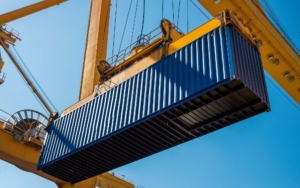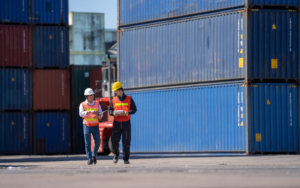

The International Longshoremen’s Association (ILA) faced a defining moment as its labor contract with the United States Maritime Alliance (USMX) approached expiration on September 30, 2024. The ILA represents over 70,000 dockworkers across 36 coastal ports in the U.S. and Canada — including major hubs in New York/New Jersey, Savannah, Baltimore, and Houston. A work stoppage would have been the first multi-coast ILA strike since 1977, and the economic consequences were staggering: 43–49% of all U.S. container imports flow through East and Gulf Coast ports.
This article covers the historical roots of the ILA’s labor position, the core issues driving the 2024 negotiations, and the operational implications for importers navigating one of the most significant supply chain challenges of recent years.
Quantify your exposure in 20 minutes
Our trade strategists run your last 90 days of entries through Captain to surface refund eligibility, Section 232 traps and PNTR risk.
Background of the Negotiations
The ILA-USMX negotiations that defined 2024 did not begin in a vacuum. They were the culmination of years of unresolved tension over two fundamental issues: compensation and technology. Understanding how those tensions developed reveals why the 2024 standoff was so difficult to resolve.
The 2023 Breakdown and Lead-Up
The current ILA-USMX negotiating cycle formally opened in February 2023. ILA President Harold J. Daggett entered talks as a hardliner, particularly on the issue of automation. He had long argued that shipping companies — many of which reported record profits during the COVID-era freight surge — were accelerating automation deployments to reduce labor dependency while demanding wage restraint from workers.
The breakdown point came in July 2023, when Daggett accused USMX — whose membership includes major carriers like Maersk — of deploying automated terminal technology in violation of the existing labor agreement. Maersk disputed this claim, arguing its technology remained within contractual bounds. The dispute was enough to suspend negotiations, leaving more than a year of talks needed before the September 30, 2024 deadline.
What the ILA Was Demanding
By mid-2024, the ILA’s position had hardened around several non-negotiable demands:
- Wage increases commensurate with the shipping industry’s COVID-era profits — reports circulated of an ask as high as 78%, though Daggett characterized even a $5/hour increase over six years as a reasonable annual ~10% adjustment
- A complete ban on new automation — including semi-automated systems — unless mutually agreed upon with the union
- Job security guarantees for existing dockworkers whose roles were threatened by technology
USMX countered that it had complied with all existing agreement terms, had not unilaterally deployed prohibited automation, and wanted to return to the table. Both sides acknowledged the strike risk; neither was willing to move first.
Core Issues: Wages and Automation
The 2024 ILA dispute was at its core about two forces in tension: labor’s share of industry profits and the future of work in automated ports. These issues were not new, but the scale of COVID-era carrier profits had made the wage gap impossible to ignore.
The Wage Gap
From 2020 to 2023, the major ocean carriers that make up USMX membership collectively earned hundreds of billions in net profit — far exceeding any prior period in the industry’s history. ILA leadership pointed to this data repeatedly, arguing that a 78% wage ask over the contract period was not unreasonable against that backdrop. USMX countered that normalized post-COVID shipping economics could not sustain the same wage trajectory.
The wage dispute was resolvable in principle. Automation was not — at least not within the framework of a single contract negotiation.
The Automation Battle
Daggett’s opposition to automation was categorical. The ILA had watched West Coast ports, represented by the ILWU, negotiate semi-automated systems into existence over the prior decade — sometimes with productivity gains that ultimately reduced headcount. The ILA was determined not to repeat that outcome.
What made the automation issue structurally intractable was that port operators had legitimate efficiency arguments: automated systems operate 24/7, reduce error rates, and lower operational costs. For carriers already under pressure from normalization of freight rates, automation offered a path to margin recovery. The ILA’s insistence on a ban made any accommodation politically difficult for USMX’s members.
Political and Economic Implications
The potential strike quickly attracted political attention at the highest levels. The economic stakes were too large to ignore: with 147 vessels carrying over $34.3 billion worth of freight en route to East Coast and Gulf ports by October 1, even a brief stoppage would have cascading effects.
Federal Response and the Taft-Hartley Question
The Biden administration signaled it would not invoke the Taft-Hartley Act to force workers back to the job. Transportation Secretary Pete Buttigieg acknowledged the situation’s gravity but insisted a negotiated resolution was the only path. This was a significant political commitment: using Taft-Hartley would have alienated organized labor in an election year.
In practice, the administration’s approach was to encourage direct negotiation rather than compel a return to work. That meant any resolution had to come from the parties themselves — which increased the leverage of both sides but also the risk of a prolonged standoff.
Industry and Supply Chain Impact
Port executives and logistics providers began contingency planning weeks before the deadline. Beth Rooney, director of the Port Authority of New York and New Jersey, confirmed preparations for cargo flow management to prevent terminal pile-ups. Steve Lamar, president of the American Apparel and Footwear Association, warned that a prolonged strike could cause lasting damage to East Coast port business as importers permanently rerouted volumes to West Coast alternatives.
The industries most exposed were:
- Retail — holiday inventory in transit; any delay would ripple into Q4 stock availability
- Automotive — parts supply chains depend on tight East Coast port scheduling
- Agriculture — exporters faced the prospect of perishable goods rotting on docks or in containers
- Pharmaceuticals — time-sensitive medical supply imports concentrated on USEC
Audit your derivative HTS exposure
Our brokers will review your top 50 derivative HTS lines and flag Section 232 valuation risk before CBP does.
Support from the ILWU
The ILA was not negotiating in isolation. The International Longshore and Warehouse Union (ILWU), which represents West Coast dockworkers under a contract running to 2028, formally endorsed the ILA’s position. ILWU International President Willie Adams pledged full solidarity, particularly around the automation issue.
This cross-union alignment was significant for two reasons. First, it demonstrated that the automation debate was a shared concern across dockworker unions, not an ILA-specific grievance. Second, it complicated carrier strategies to redirect volume to West Coast ports as a strike contingency — ILWU members could theoretically engage in sympathy actions, although the 2028 contract constrained formal solidarity strikes.
The last time the ILA went on strike was in 1977 — a multi-coast action that lasted 45 days. The institutional memory of that disruption loomed over 2024’s negotiations as a reminder of what a protracted standoff could mean for U.S. trade infrastructure.
Strategic Responses from the Shipping Industry
In advance of the potential October 1 work stoppage, the freight industry activated a range of contingency responses. These responses illustrate exactly why real-time supply chain visibility software and advance planning are so critical during labor uncertainty.
Carrier and Port Actions
- Several ocean carriers began embargoing export cargo to East Coast ports from Midwest origin points
- Houston and New York/New Jersey ports implemented extended gate hours and pre-strike cargo clearance programs
- Long Beach Port reported a measurable freight uptick as importers diverted to USWC
- Blank sailing announcements accelerated to manage capacity if USEC volumes fell
Importer and Forwarder Actions
- Transloading: Moving containers from USWC ports via rail and truck to East Coast destinations, accepting higher inland transportation costs as an insurance premium
- Air freight conversion: Time-sensitive goods — particularly electronics, pharmaceuticals, and apparel — were pre-booked onto air as a more expensive but guaranteed-delivery alternative
- Advance purchasing: Many importers accelerated Q4 purchase orders, pulling inventory forward by 4–8 weeks to arrive before the strike deadline
- Carrier diversification: Splitting volume across both USEC and USWC services reduced single-port-of-entry exposure
Importers who had implemented a Control Tower platform with real-time shipment tracking were able to identify in-transit cargo, model rerouting costs, and execute decisions faster than those relying on manual reporting. The value of visibility infrastructure became tangible in the days leading up to September 30.
What Importers Can Do: Lessons for Future Labor Disruptions
The 2024 ILA situation ultimately resolved with a temporary wage agreement in early October — a short extension that allowed further negotiations to continue. But the structural tensions around automation remain unresolved, making future labor actions a continuing risk for East Coast importers. The preparedness actions that proved most effective in 2024 apply to any future disruption:
Risk Management Before a Strike
- Map all open purchase orders and in-transit shipments by port of entry — know your USEC exposure precisely
- Establish pre-qualified transloading partners at USWC ports before a crisis
- Build 4–8 weeks of safety stock for critical SKUs that move exclusively through USEC
- Review your carrier agreements for strike clauses and alternative routing provisions
Tariff and Compliance Preparedness
Labor disruptions often intersect with tariff complexity — particularly when cargo is rerouted across different customs clearance points. Understanding customs clearance requirements for both USEC and USWC entry points ensures that rerouted cargo clears without delays that negate the routing switch’s benefits.
Similarly, if you are rerouting cargo to reduce tariff exposure — for example, shifting sourcing from China to Vietnam under current Section 301 tariffs — the port-of-entry change needs to be coordinated with your customs broker and trade advisory services team to preserve classification and origin documentation integrity.
The Road Ahead
The 2024 ILA negotiations established a precedent: labor action at East Coast ports is a credible, periodic risk for U.S. importers, not a theoretical one. The automation dispute is unresolved. Wage expectations have been ratcheted upward. Future contract cycles will face the same structural tensions, but in a freight market that has normalized from COVID-era extremes — meaning carrier profit cushions are smaller and cost pass-through to shippers is more likely.
For supply chain professionals, the response is structural rather than reactive: building the visibility infrastructure and routing flexibility to respond quickly, and partnering with supply chain risk management advisors who can model disruption scenarios before they occur rather than after cargo is already stuck at a closed terminal.
The ILA’s 2024 actions set a clear signal that dockworker leverage at East Coast ports remains high — and that any shipper with significant USEC exposure needs a contingency plan as a permanent fixture of their logistics strategy, not an emergency response.