We combine every legal lever into one quantified plan, then run it on your live entries —
classification, valuation, First Sale, FTA, and drawback delivered by advisors who also file the entries.
Customs duty consulting is the work of paying the right duty and no more: classification, valuation, origin, and the programmes that legally lower what an importer owes. Customs duty reduction consulting is the disciplined pursuit of every legal way to lower what you pay at the border. It treats duty as a variable cost, not a fixed one, and works four fronts at once: how your goods are classified, how they are valued, where they originate, and which recovery programs you can claim.
CargoTrans folds tariff classification and optimization, duty reduction and mitigation strategies, First Sale and tariff engineering, Free Trade Agreement (FTA) optimization, customs valuation and compliance with transfer pricing alignment, and trade compliance audits into one quantified plan, coordinated through our tariff and trade advisory desk so the levers reinforce rather than cancel each other.
This is advisory plus execution. The plan we design runs on your live entries, and recovery programs like duty drawback are filed by the same team, with First Sale for Export typically the largest single lever for importers buying through a middleman. Because savings are quantified against your real entries before you commit, the engagement is measured against dollars returned, not effort spent.
10-30%
First Sale duty cut
up to 99%
Drawback recovery
24h
Response time
Free Duty Analysis
Talk to a Duty Reduction Advisor
Quick 30-min analysis of where your duty is highest and most reducible. No obligation.
We reply within 1 business day · Your data stays private.
Capabilities
What Our Customs Duty Consulting Covers
Six advisory levers our consultants use to legally reduce and recover the customs duty you pay.
01
Tariff Classification and Optimization
We verify every HTS number and reclassify where a defensible, lower-duty heading applies.
Line-by-line HTS review and validation
Duty rate comparison across headings
Binding rulings for gray-area goods
Overpayment identification and recovery
02
First Sale and Tariff Engineering
We value goods on the factory price where First Sale qualifies, and engineer products toward lower-duty outcomes.
First Sale eligibility and documentation
Material and condition-as-imported planning
Set and kit configuration review
03
Duty Drawback and Recovery
We recover up to 99 percent of duty paid on goods that are later exported or destroyed.
Manufacturing and unused merchandise claims
Substitution drawback analysis
Retroactive claim filing and recordkeeping
04
FTA Optimization
We qualify goods under Free Trade Agreements so eligible duty drops toward zero.
Rules-of-origin qualification
Certificate and solicitation management
Sourcing shifts to unlock preferences
05
Customs Valuation and Compliance
We set a defensible valuation basis and align it with your transfer pricing so duty is neither overpaid nor exposed.
Dutiable value and assist review
Transfer pricing alignment
Reconciliation and adjustment support
06
Trade Compliance Audits
We audit your import program so duty reduction rests on defensible, documented positions.
Why Choose CargoTrans for Customs Duty Reduction Consulting?
We quantify every lever in dollars against your actual entries before you commit, so you fund the work from projected savings rather than a promise.
The same firm that designs the First Sale program, the reclassification, or the drawback claim also files it, so reductions land on real declarations instead of a report.
We combine the levers rather than selling one, because a reclassification, a valuation change, and an FTA claim interact, and pursuing them together captures savings that any single tactic would leave behind.
Our five-step process runs from assessment to continuous optimization, so as sourcing and tariffs shift, the plan is revisited instead of going stale.
Our Process
How Our Customs Duty Reduction Process Works
01
Assessment
We pull your entry history and map duty paid by HTS, supplier, and lane.
02
Opportunity Identification
We flag every reduction and recovery lever your goods qualify for.
03
Strategy Design
We size each lever in dollars and combine them into one sequenced plan.
04
Execution
Our brokers apply the plan on live entries and file recovery claims.
05
Continuous Optimization
We track rate and sourcing changes and refresh the plan as they move.
Most importers pay more duty than the law requires, because no one has ever tested their classifications, valuation, and program eligibility against the current rules and their real entries.
CargoTrans turns that untested exposure into a quantified plan that lowers landed cost and recovers duty you have already overpaid.
Free 30-minute duty reduction analysis with a trade advisor
No-obligation savings quantified in dollars against your entries
Reduction and recovery levers combined into one executed plan
Advisory and brokerage execution from one accountable team
A CargoTrans advisor will quantify where your duty is highest and how much of it is recoverable.
Protected by reCAPTCHA. We respond within 1 business day. No spam, ever.
Control Tower
Duty Reduction, Live in the Control Tower
The real-time Control Tower shows duty paid by HTS code, supplier, and product family, so the concentration you should attack first is visible at a glance instead of buried in a year of entry data.
The same platform runs our customs duty software, which models the dollar impact of a reclassification, a First Sale program, or an FTA claim before you implement it, so every reduction move is a decision backed by numbers.
Customs Duty Reduction Records That Survive an Audit
Every reduction we implement is documented as it is applied, so the reasonable care behind a First Sale valuation, a reclassification, or an FTA claim is built on the entry rather than reconstructed once CBP asks how you got there.
Because Captain Trade Advisory and Trade Compliance tie our work to the record your brokers file against, a valuation question or an origin challenge is answered by the team that designed the savings, which is what keeps aggressive but legal reductions defensible.
It is advisory work focused entirely on lowering what you pay at the border, backed by the execution to make it real. Rather than treating duty as a fixed cost, it tests four things: whether your goods are classified under the lowest defensible HTS heading, whether they are valued correctly, where they originate for preference purposes, and which recovery programs you can claim. At CargoTrans we combine classification optimization, First Sale, tariff engineering, FTA use, valuation alignment, and drawback into a single plan, then file it on your live entries. Because we quantify each lever in dollars against your real data first, you fund the work from projected savings instead of paying for a study that may or may not pay off.
How much can I realistically reduce my duty?
The honest answer depends on your products, volume, and how your imports are structured, which is why we start by reading your entries. The levers do have known ranges, though. Where goods qualify, First Sale routinely lowers the applicable duty by roughly 10 to 30 percent. Reclassification can shift a rate by several points across an entire product line. Drawback recovers up to 99 percent of duty on goods you later export. FTA qualification can drop eligible duty toward zero. Combined, these often reduce landed-cost duty by a meaningful double-digit percentage. We quantify each lever against your actual entries before you commit, so you evaluate a projected dollar figure rather than a headline percentage that may not apply to your goods.
What is tariff classification optimization?
Every imported good carries an HTS number that fixes its duty rate, and many products can legitimately sit under more than one heading with different rates. Importers often inherit a classification picked for speed years ago and overpay ever since. Classification optimization reviews your codes line by line, compares defensible headings, and reclassifies where a lower-duty code genuinely applies to the article as imported. Where the answer is close, we can request a binding ruling to lock in the position. It also surfaces cases where you are underpaying and exposed to penalties, since accuracy protects you both ways. Across a high-volume product line, moving even a point or two of duty compounds into real money every shipment.
What are duty reduction and mitigation strategies?
Duty reduction and mitigation is the umbrella for every legal tactic that lowers your duty exposure, chosen and sequenced for your specific imports. It spans classification changes, valuation adjustments, First Sale, tariff engineering, FTA qualification, country-of-origin planning, Foreign Trade Zone use, and drawback recovery. The skill is not knowing the list, it is knowing which levers fit your goods, how much each returns, and in what order to apply them so they reinforce rather than conflict. We build that into one plan tied to dollars, then execute it. Mitigation also means preparing for tariff actions before they hit, so a new duty becomes a decision you make early rather than a cost you simply absorb.
What is duty drawback and recovery?
Duty drawback lets you recover up to 99 percent of the duties, taxes, and fees paid on imported goods that are later exported or destroyed. If you import components and export finished products, or re-export unused merchandise, that duty is often refundable but frequently goes unclaimed because the recordkeeping is demanding. We assess eligibility across manufacturing, unused merchandise, and substitution drawback, then build and file the claims. Because claims can reach back several years, a first filing often returns a substantial lump sum before becoming an ongoing recovery stream. For any importer that also exports, drawback is one of the largest and most overlooked pools of recoverable cash sitting inside the operation, waiting only on the documentation to unlock it.
How does FTA optimization cut duty?
The United States maintains trade agreements that let qualifying goods enter at reduced or zero duty, but the benefit is not automatic. Goods must meet the specific rule of origin for their classification, and you must hold valid supporting documentation. Many importers either miss preferences they qualify for or claim ones they cannot defend under audit. FTA optimization analyzes which agreements your goods can use, confirms the rules of origin are actually met, and manages the certificates and supplier solicitations that make the claim hold up. Where your sourcing is close to qualifying, we model the shift that would unlock the preference and weigh the duty saved against the cost of changing suppliers, so the decision is grounded in numbers.
What is customs valuation and how does it affect duty?
Duty is generally charged as a percentage of your goods' customs value, so how that value is determined directly drives how much you pay. The rules define what must be included, such as certain assists, royalties, and commissions, and what may be excluded. Get it wrong high and you overpay on every entry; get it wrong low and you face penalties. Valuation work reviews your dutiable value, checks that assists and additions are handled correctly, and confirms the basis is defensible. For importers buying through a middleman, it also opens the door to First Sale, where value is set on the lower factory price. Correct valuation is often the quiet difference between an efficient duty bill and a leaking one.
How does transfer pricing align with customs valuation?
When you import from a related company, two authorities care about the price: customs wants a value high enough to collect proper duty, and tax authorities scrutinize transfer pricing for income shifting. Those pressures pull in opposite directions, and a transfer price set purely for tax reasons can create customs exposure, or vice versa. Alignment means setting an intercompany price that satisfies both regimes and documenting it so neither can challenge it in isolation. We review your related-party pricing against customs valuation rules, coordinate with your transfer pricing basis, and use tools like reconciliation where post-import adjustments occur. Done well, it prevents the common trap where a defensible tax position quietly becomes an indefensible customs one.
What is First Sale and how does it reduce duty?
With First Sale for Export, an importer that qualifies bases customs value on the factory-to-middleman price rather than the higher amount the middleman later invoices. Because duty tracks that earlier, lower price, qualifying importers commonly shave 10 to 30 percent off their duty. It applies when there is a genuine multi-tier sale, the transactions are at arm's length, and the goods are clearly destined for the United States at the time of the first sale, all backed by disciplined documentation. For importers buying through trading companies or agents, it is usually the single largest duty-reduction lever available. We test eligibility, restructure the flow where needed, and build the audit trail so the benefit holds up under review.
What is tariff engineering?
Tariff engineering is the legal practice of designing or configuring a product so it falls under a lower-duty classification, judged by its condition as actually imported. It rests on a long-settled principle that goods are classified as they arrive at the border, not by their later use. Common approaches include adjusting materials or composition, importing components rather than finished sets, or changing how goods are packaged and assembled. The requirement is that the change be real and the goods classified honestly for what they are. We analyze your products for compliant engineering opportunities and document the basis, so a lower rate rests on the genuine article rather than a paper characterization that would collapse the moment customs looked closely.
What is a trade compliance audit and why does it matter for savings?
A trade compliance audit reviews your import program the way CBP would, checking classification, valuation, origin, and documentation for accuracy and defensibility. It matters for savings because aggressive duty reduction only pays off if it survives scrutiny. A reclassification or a First Sale program that cannot be defended is not a saving, it is a deferred penalty. The audit confirms your reduction strategies rest on documented, correct positions, and it also finds overpayments hiding in the current program that you can recover. In practice, compliance and savings are the same project: the discipline that keeps you defensible is the same discipline that reveals where you have been quietly overpaying and where a lower position is genuinely available.
Do you only advise, or do you also execute the plan?
We do both, which is the point. Many advisors deliver a report and leave implementation to your broker, and that handoff is where good strategies quietly stall. CargoTrans pairs advisory with execution: the same team that designs a First Sale program, a reclassification, or a drawback claim also files the entries and the claims. The reductions therefore land on real declarations, the documentation is built as goods move, and there is no gap between plan and practice. When customs raises a question, the answer comes from the people who designed and filed the position. Advisory plus execution is why our engagements are measured in duty actually reduced, not recommendations delivered.
What does the five-step process look like?
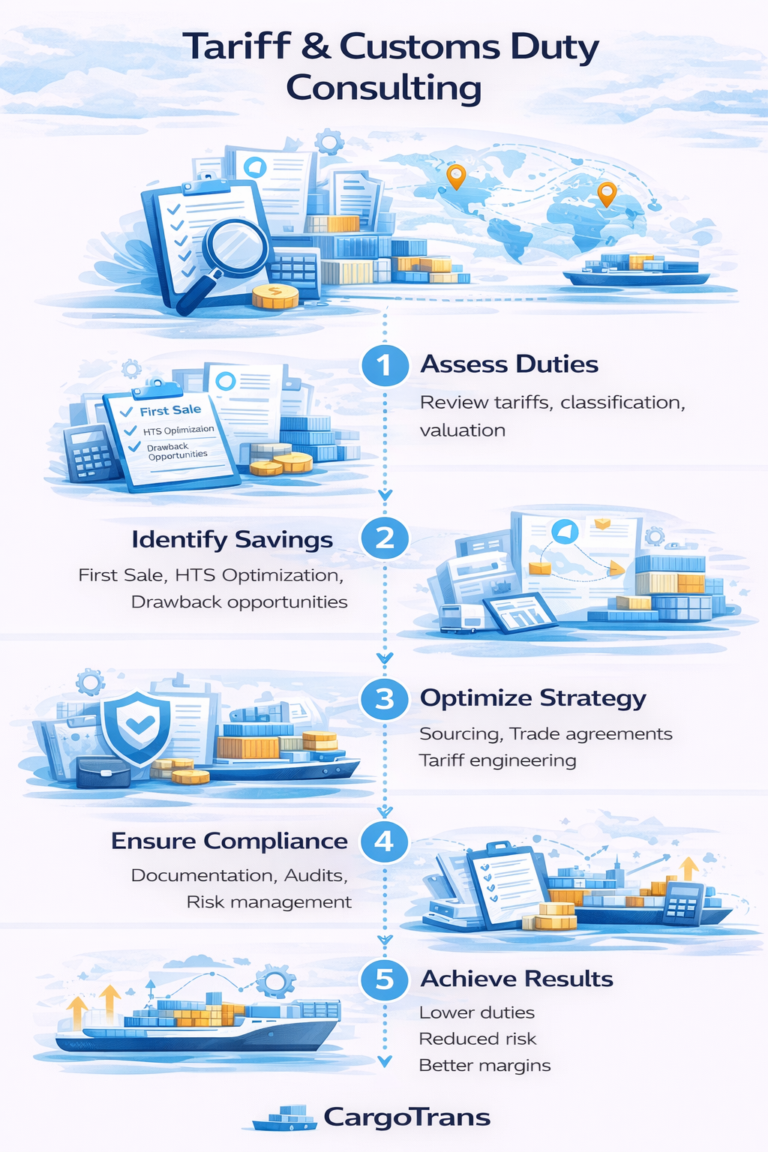
Every engagement runs through five stages. First, assessment: we pull your entry history and map duty paid by HTS, supplier, and lane. Second, opportunity identification: we flag every reduction and recovery lever your goods qualify for. Third, strategy design: we size each lever in dollars and combine them into one sequenced plan rather than a menu of disconnected tactics. Fourth, execution: our brokers apply the plan on live entries and file recovery claims like drawback. Fifth, continuous optimization: we track rate and sourcing changes and refresh the plan as they move. The structure keeps the work quantified and executed, so you always know what each move is worth and whether it has actually been captured.
How do we get started?
It starts with a free 30-minute analysis. Send recent entry data and we will map where your duty is highest and flag the levers most likely to reduce it, at no cost and no obligation. From there a full assessment quantifies each opportunity in dollars, including recoverable duty you may have already overpaid through drawback or misclassification, so you decide what to pursue based on projected return. Fees are scoped to the work, often project-based around a specific lever like First Sale or drawback, with ongoing optimization sized to your volume. Because we quantify the return up front, the decision on any move is simply whether it clears its cost, which for most importers it comfortably does.