As the global trade environment continues to evolve, shippers and exporters must plan ahead with greater precision and discipline than ever before. The landscape of tariffs on US products in 2026 is marked by potential policy shifts, retaliatory measures from multiple trading partners, and the continued geopolitical debate over trade protectionism and strategic decoupling. For US companies selling goods abroad, understanding the potential for increased foreign tariffs on American exports is crucial for accurate cost forecasting, contract pricing, and maintaining long-term competitiveness in key markets.
This uncertainty requires more than reliable logistics. It demands proactive, data-driven planning supported by tools that can surface emerging tariff risks, model their financial impact across your product portfolio, and give operations teams the agility to respond before new duties create costly disruptions. At CargoTrans Inc., we are committed to providing the visibility and advisory capabilities that help small and mid-sized shippers turn potential trade turbulence into a competitive advantage — not just a cost to manage.
Quantify your exposure in 20 minutes
Our trade strategists run your last 90 days of entries through Captain to surface refund eligibility, Section 232 traps and PNTR risk.
The Global View: Key Markets and Potential Tariff Risks
Tariffs on US products are rarely uniform across trading partners. They vary based on the importing country’s trade relationship with the United States, its domestic political priorities, and the specific product sectors under discussion. Managing this complexity requires a market-by-market analysis rather than a generalized risk assumption. The major trade corridors each carry distinct risk profiles that US exporters must monitor continuously.
Key Areas of Concern for Tariffs on US Products
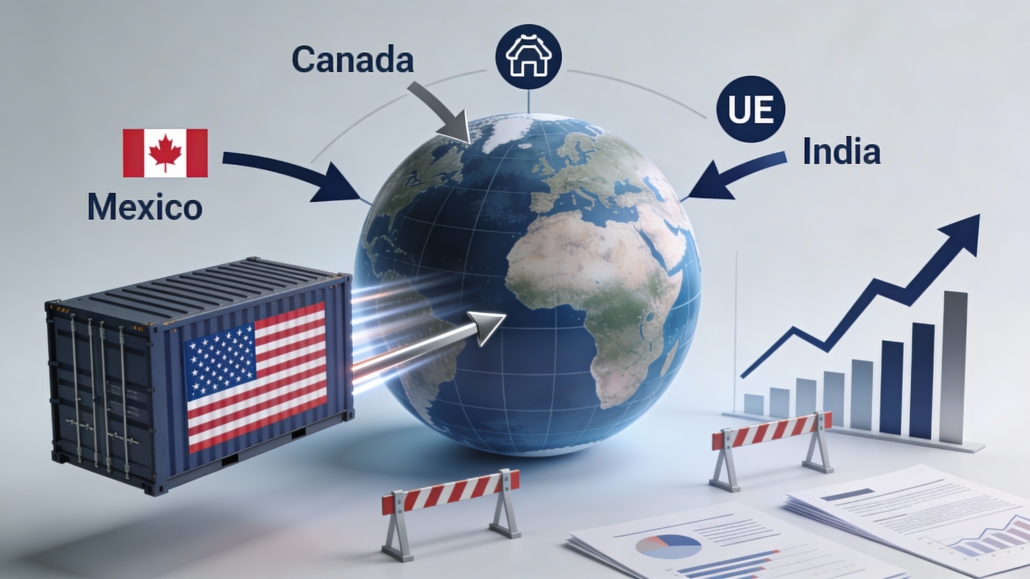
The following markets represent the most significant tariff risk exposure for US exporters in the current trade environment:
- Canada and Mexico (USMCA Partners): While trade is largely free under the USMCA framework, the threat of Section 301-style or other retaliatory measures remains a key concern. Any trade friction can see targeted tariffs on specific US sectors — agriculture, manufacturing, and industrial goods have historically been the first targets when USMCA partners respond to US trade actions.
- The European Union: The EU has a well-established pattern of implementing retaliatory tariffs in response to US trade measures. Past cycles have targeted American bourbon, motorcycles, denim, and agricultural products — high-visibility consumer goods chosen for their political impact. Renewed tensions in 2026 could trigger new rounds of tit-for-tat duties across a broader range of US-manufactured goods.
- China: The bilateral trade relationship remains the most complex and highest-stakes environment for US exporters. Tariffs on US products in China span agricultural commodities, aerospace components, chemicals, and manufactured goods. Any escalation in bilateral tensions creates asymmetric exposure for US companies that have not diversified their market presence.
- India and Emerging Markets: Countries like India use tariffs as a tool to protect nascent domestic industries and negotiate from positions of leverage. US exporters must monitor tariff levels in India across electronics, medical devices, agriculture, and manufactured goods — categories where India has historically applied or threatened elevated duties in response to US trade actions.
The Historical Context: Understanding the Baseline
It is important to remember that tariffs are a longstanding feature of international trade — not a recent invention of any particular political moment. Before major trade disputes emerged, tariffs on US products were primarily based on Most-Favored-Nation (MFN) rates established through WTO negotiations or specific anti-dumping duties applied after formal investigations. Understanding this baseline is essential for distinguishing between routine trade taxes and politically motivated surcharges that may be temporary — and therefore subject to negotiation — versus structural features of the bilateral trade relationship that require longer-term strategic adjustment.
The current environment has layered significant retaliatory and strategic tariffs on top of the MFN baseline. US exporters managing their exposure need to know both layers: the standard duty rate their products face, and any additional tariffs imposed in specific trade disputes that could be modified by future negotiations.
Preparation Is Key: Leveraging CargoTrans Inc.’s Digital Tools
Forecasting the financial impact of potential tariff changes on US products requires real-time, accurate data combined with scenario-modeling capabilities that go beyond what spreadsheets can provide. CargoTrans Inc. provides two integrated tools that empower shippers to stay ahead of policy changes — responding to new tariffs in hours rather than weeks, and building contingency plans before the regulatory landscape shifts beneath them.
1. Tariff Tracker Tool: Your Proactive Cost Forecaster
The Tariff Tracker is designed to provide immediate clarity on the complex, layered duty structures that US exporters face across global markets. Rather than waiting for customs consultants to provide manual analysis, shippers can access current and projected tariff information directly from their operational platform.
- Model future scenarios — Input your Harmonized System (HS) codes and target destination countries to immediately see the potential financial impact of hypothetical tariff increases, reinstatements, or new retaliatory measures being discussed in current trade negotiations.
- Track retaliatory duties in real time — Quickly identify whether your specific product codes are subject to elevated retaliatory tariffs in key export markets, and receive alerts when applicable rates change.
- Ensure duty payment accuracy — Confirm that the duties you are paying — or that your customers abroad are paying — align with the latest published tariff schedules, minimizing audit risk and preventing overpayment that erodes margin.
- Compare sourcing and manufacturing scenarios — Evaluate how shifting production inputs or manufacturing location affects the duty exposure of your finished goods in target export markets.
2. Control Tower Dashboard: Operational Agility Under Uncertainty
When new tariffs on US products are announced — and experience shows they can be announced with very little warning — operational agility is what separates shippers who adapt quickly from those who absorb costs reactively. The Control Tower platform provides the real-time operational intelligence needed to respond decisively when the trade policy landscape shifts.
- End-to-end location data — Complete supply chain visibility software across air, ocean, and land allows you to know exactly where every shipment is in the pipeline — critical information when you need to decide whether to delay, reroute, or accelerate cargo in response to a new tariff announcement.
- Proactive alerting — Receive timely notifications that enable critical routing and timing decisions — such as delaying a shipment until a tariff situation is clarified, or accelerating dispatch to clear customs before a new duty takes effect.
- Unified documentation management — Access all trade documents in one place to respond quickly to customs inquiries that accompany periods of heightened regulatory scrutiny triggered by new tariff measures.
- Mode and route optimization — Analyze air vs. ocean freight trade-offs in real time, factoring updated tariff costs into mode selection decisions that affect both transit time and total landed cost.
Building a Tariff-Resilient Export Strategy
Beyond individual shipment management, US exporters need to think about structural resilience — building an export strategy that can adapt to tariff changes across multiple markets without requiring a complete operational overhaul each time the trade policy environment shifts. This requires disciplined planning across several dimensions that reinforce each other.
Strategic Diversification
Exporters that depend heavily on a single foreign market for a significant portion of their revenue face concentrated tariff risk. A strategic diversification approach reduces this exposure:
- Identify alternative markets for key product lines where US goods face lower tariff barriers or where trade agreements provide preferential access.
- Build relationships with distributors and buyers in multiple countries so that if one market becomes less competitive due to tariffs, others can absorb more volume.
- Use the Tariff Tracker to continuously monitor the duty landscape across your full portfolio of target markets, not just the primary ones.
Contractual and Pricing Discipline
Export contracts that do not address tariff risk leave US exporters exposed when foreign buyers face unexpectedly higher costs. Proactive contract design can protect relationships and margins:
- Include tariff escalation clauses in long-term supply agreements that address how costs are shared if applicable duties increase beyond a defined threshold.
- Price goods with explicit reference to current duty levels so that buyers understand the cost structure and are positioned to renegotiate on a principled basis if tariffs change.
- Align Incoterms choices with the risk allocation that makes sense given current tariff exposure — DDP terms, for example, leave the exporter bearing all duty risk in the destination country.
Compliance as Competitive Advantage
In tariff-sensitive environments, shippers whose documentation, classification, and origin substantiation are consistently accurate experience fewer holds, faster clearance, and lower effective duty costs than those who cut corners. Supply chain risk management that incorporates compliance discipline — not just logistics efficiency — is what enables exporters to maintain reliable service levels even when trading conditions become politically complicated.
Working with trade advisory services that understand both the regulatory landscape and the operational logistics of US export shipping ensures that compliance decisions and freight decisions are made together rather than in isolation. And for businesses that want to understand the full duty implications of their export strategy across different markets and scenarios, Captain’s tariff calculator provides the analytical foundation for those decisions.
What to Do When Tariffs Are Announced
When a new tariff on US products in a key export market is announced, the first hours and days are often the most consequential. Having a response protocol in place before tariffs are announced — rather than building one in the heat of the moment — is what allows exporters to act decisively rather than reactively.
- Immediately assess which shipments in transit will be affected by the new duty and whether any can be accelerated to clear customs under the prior tariff rate.
- Review the HS code coverage of the new measure to determine exactly which product lines are affected — tariff actions are rarely blanket; they typically target specific codes.
- Model the landed cost impact of the new duty across your affected product portfolio and communicate proactively with buyers about pricing implications.
- Identify any exclusion processes, renegotiation opportunities, or alternative sourcing or manufacturing configurations that could reduce exposure over the medium term.
The supply chain challenges created by sudden tariff announcements are most manageable for businesses that have already invested in the visibility and advisory infrastructure to respond at speed.
Control Your Supply Chain, Not the Tariffs
You cannot control global trade policy, but you can control how well-prepared your organization is to respond to it. For US shippers and exporters managing the potential volatility of tariffs on their products in 2026 and beyond, the combination of reliable freight forwarding, real-time operational visibility, and proactive trade advisory support is the foundation of a resilient export strategy.
Don’t let uncertainty derail your global sales. Partner with CargoTrans Inc. to move your goods efficiently across all modes and markets, and use the Captain ecosystem to master your trade cost management — modeling scenarios, monitoring duty changes, and maintaining the operational agility to respond when the landscape shifts.
Ready to model the landed-cost impact of potential tariff changes on your specific US export products? Use Captain’s tariff calculator to get started, or connect with our trade advisory services team for a customized analysis of your tariff exposure across your key export markets.